For Crop Protection, 2025 Begins the ‘ESA Era’
 January 15, 2025
  There is going to be plenty of activity in the crop protection paroducts marketplace in 2025. However, much of this will be tied not to sales and application rates, but to changes coming for all segments of the industry due to the implementation of the Endangered Species Act (ESA).
But before looking forward to 2025, a look back is in order. According to the 2024 CropLife 100 survey, the nation’s top ag retailers experienced a 2.6% revenue decline for their crop protection products last year with sales topping out at $15.3 billion. According to most industry watchers, companies and grower-customers buying more products in advance, “just in case” meant everyone in the business was well stocked on crop protection products.
However, all of the news for the crop protection products category wasn’t bad in 2024. Because the category didn’t decline as rapidly as other crop inputs/services categories among ag retailers, the overall market share did improve. For 2024, crop protection products now hold a 36% market share among CropLife 100 ag retailers compared with other crop inputs such as fertilizer and seed. This represented a 2% improvement from the 34% market share the category held according to the 2023 CropLife 100 survey.
And there was positive market activity for some crop protection products in 2024. For example, Adastrio fungicide from FMC Corp., which contains the active ingredients flutriafol, fluindapyr, and azoxystrobin and was introduced in 2023, continued to make marketplace inroads.
“In its second year, Adastrio fungicide sales expanded 16 times the first year,” says Matt Kampschnieder, Portfolio Manager – Herbicides & Fungicides at FMC. “This fungicide meets the growing demand for a tar spot product for corn growers.”
And more new products are on the way for 2025. Corteva Agriscience is planning to launch a pair of new soybean herbicides this year – Kyber Pro (containing the active ingredients metribuzin, flumioxazin, and pyroxasulfone) and Sonic Boom (with the active ingredients metribuzin and sulfentrazone).
Over at BASF, the company is introducing Liberty ULTRA herbicide powered by Glu-L Technology and containing the active ingredient L-glufosinate ammonium. “With a narrowing number of effective knockdown tools in the U.S., Liberty ULTRA herbicide will offer American farmers a post knockdown tool that delivers improved performance and convenience,” says Matt Malone, Product Manager. Significantly, Liberty ULTRA is also one of the first new crop protection products to have its label approved incorporating the new ESA rules.
Keeping an Eye on ESA
By way of some background, the new rules pertaining to ESA came into play in August 2024. According to Jeffrey Smith, Associate Director of Industry & Government Relations at Valent U.S.A. LLC, the new rules boiled down to a conflict between two different existing laws — ESA and the Federal Insecticide, Fungicide and Rodenticide Act (FIFRA).
“These two laws were written without each other in mind,” said Smith, speaking at the 2024 Mid America CropLife Association meeting last September. “FIFRA is administered by EPA while ESA is administered by the federal services. These have different requirements, with ESA being a risk-based assessment, so that if any species could be harmed by a product, EPA has to consult with the services before considering any registration.” According to Smith, there are currently more than 1,200 active ingredients in the marketplace that fall under the new ESA rules, potentially impacting 1,700 species and 800 critical habitats.
Crop protection suppliers are already experiencing some of the consequences of ESA with their planned product launches. For instance, Syngenta Crop Protection has had two new product innovations — Tymirium seed care for soybeans and Plinazolin insecticide (featuring the new active ingredient isocycloseram) – for several years now. However, neither of these products have received final registrations at the federal level for market use yet, largely because of the label changes required under ESA.
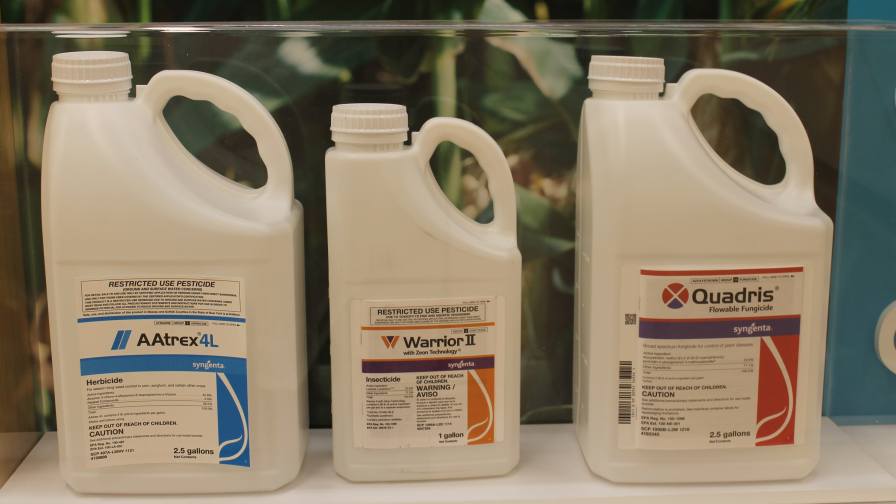
A trio of crop protection products on display at Syngenta’s headquarters in Greensboro, NC.
“We invest a lot in research and development for new products,” said Vern Hawkins, Regional Director, North America President, speaking at Syngenta’s Media Summit in October. “And we are not the only ones experiencing this. You can bet every other company investing in research and development is experiencing it, too.”
The problems are two-fold, he said. First off, the agency charged with product registrations, EPA, is underfunded and undermanned. As originally conceived, the funding mechanisms for EPA under PRIA had crop protection companies paying 30% of the costs to operate this program with Congress appropriating the remaining 70%. However, instead of providing the $166 million in funding it was supposed to for the agency, Congress has only appropriated $134 million.
In terms of personnel, EPA used to have 900 employees working on registrations. But because of retirements and cutbacks, the number of people working on product registrations at EPA will fall to 453 by 2026.
“When you look at what’s going on in EPA right now — and the backdrop of ESA and its legal influence — the agency is spending much of its time defending its decisions in court before doing any work on registering new products,” said Hawkins. “And the people doing these court battles are the same ones that do the risk assessments on registering new products. That’s a problem.”
With ESA changes already in place (or agreed to) for herbicides and fungicides, insecticides are next on the docket, with rule changes to be in place by the end of the year. So, for crop protection products, suppliers, ag retailers, and growers, the uncertainty surrounding product label is likely to continue throughout the rest of 2025.
Subscribe Today For
