How Fry Brothers Fertilizer & Chemical Developed a Niche Market for Dry Glyphosate
 December 2, 2024
 Glyphosate has long been one of the most popular herbicides in the crop protection marketplace. Despite crops showing resistance the product remains among the most popular product available to growers around the world. As a generic available from major manufacturers around the world, it’s a wonder why a relatively small provider would spend the time and expense to create a competing glyphosate offering. But that is just what Kevin Fry, Owner of Ewing, NE-based Fry Brothers Fertilizer & Chemical, chose to do. CropLife® magazine reached out to Fry to learn why he invested the time and energy to compete with companies magnitudes of order larger.
CropLife: What caused you to start this venture?
Kevin Fry: Circumstances were the main driver. It was not a grand plan or anything. I have been selling a small amount of dry glyphosate from one of my vendors into the VM market for several years. However, it was always higher priced than liquid glyphosate, hence we never tried to incorporate it into the row crop market.
The pandemic created all sorts of chaos, and the crop protection chemical industry was no exception as fears of shortages doubled and in some cases tripled prices of chemical products. Generic 5.4-pound glyphosate went to $60 per gallon as an example. My vendor of the dry glyphosate came to me and said that dry glyphosate was cheaper than current liquid glyphosate. This would have been in the fall of 2021. They asked me if I thought I could sell dry glyphosate into the row crop market. I took a risk and bought some. In fact, I bought almost $1 million worth. That’s how it got started.
CL: When did you realize that this could be a viable solution?
KF: I had several small- and medium-sized farmer customers and one dealer customer who initially began to use the dry glyphosate. In the 2022 season, we could price it below liquid glyphosate so I was fairly confident we could make some initial sales.
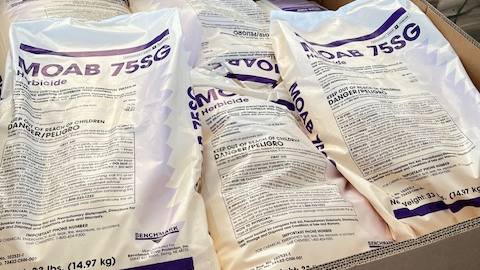
MOAB is packaged in 33- and 36-pound bags per pallet.
The dealer-customer who worked with us quickly came back with a positive response. They said it mixed well and they even thought its efficacy in killing weeds was as good or even better than the liquid.
Our farmer customers who used it initially came back for post-emerge spraying. Needing more glyphosate they would say, “I need some more glyphosate – and give me that dry stuff.” At that point I felt there could be a market.
CL: What challenges did you face?
KF: After this, I knew the biggest challenge was going to be whether or not we could price the product competitively or comparatively in the long term. Otherwise, this was just going to be a flash that would flame out once things got back to normal.
I wanted to use my current supplier so I approached them with some ideas of how we might work together. I knew once we got back to a normal market, price was going to be a hurdle. Once things got back to normal the price relationship between the dry and liquid went back to normal also. I felt the price point was too high to create any chance of having a viable market volume to support all the underlying costs and effort.
I found an industry consultant who agreed to help me navigate some things. He had extensive international commerce and regulatory experience, which is what I lacked. We found that if we had our own registration we could potentially be at least comparative with some segments of the liquid market.
CL: Tell us about the registration process.
KF: The costs of bringing a registration, I suppose, depend on many factors and some registrations will cost significantly more than others. Estimating the cost of getting a dry glyphosate product on the floor, I felt we could generate enough sales for a small company like ourselves to make it work. Larger companies I doubt would look at it. This is not going to be a high-volume product but I think it will find a niche.
CL: What were the regulatory hurdles?
KF: I was fortunate to have some people who were willing to help me who knew their way around the regulatory requirements. I just depended on their expertise. We had to jump through some hoops that took some time. I think we ended up with a good label and excellent packaging. We are working on some changes that will make it even better. We hope to have those changes completed for the coming season.
CL: How does it fit into your existing operation?
KF: We formed a new corporation to hold the registration. I felt we had to do that because our existing company did business on a wholesale and retail level. The registration of MOAB 75SG put us on a manufacturer’s level. Vendors and customers would be different.
CL: What are your expectations for the product (market size and reach)?
KF: I don’t expect MOAB 75SG is going to replace the large majority of glyphosate volume in the U.S. Trying to do something like that would set MOAB 75SG up for failure. I can see the product helping retail locations handle small- and medium-sized customers more efficiently. MOAB 75SG should replace a fair amount of glyphosate in 30s and 2×2.5s. It’s easier to handle. You don’t have drums, cardboard boxes and plastic bottles to throw away. When you’re done using MOAB 75SG, all you have left is a plastic bag to throw away.
Many retailers provide a tote along with a pump and meter to customers who don’t want to handle drums and 2×2.5s. Even some of these farmers are smaller farmers. Dealers can move these customers to MOAB 75SG and reduce the use of totes and pumps and meters, which is a cost to the dealer. Reducing the number of totes and pumps and meters to purchase and maintain is a cost savings to the dealer.
CL: How do you go about promoting the product MOAB 75SG?
KF: We only have one label so getting to market will have some challenges. The first challenge is just awareness. Most people in the U.S. ag industry don’t even know what a dry glyphosate is or how it’s used. I’ve had people think initially it gets spread on the ground as a dry product. Liquid glyphosate is so ingrained in the U.S. market’s psyche that they can’t visualize it at first.
We are going to create awareness at all three main levels of the crop protection industry, i.e., distribution, retail, and end user. I have some ideas on how it might go but I don’t want to pre-judge. I’m going to create awareness to MOAB 75SG as efficiently as possible, see where we are having success and then concentrate on that channel. We won’t have a big marketing budget.
We’re also going to do some digital marketing. Although we haven’t done much of that in our existing business, I know that it would be helpful to have some kind of digital presence. I’m a bit old school so I know I’m going to have to have some help with that also.
Lastly, I’m contemplating about making the claim that MOAB 75SG is the best glyphosate for killing weeds in the market. MOAB 75SG has a higher surfactant load than any liquid glyphosate I know. At least the ones who will tell you what load percentage they have. And MOAB’s surfactant load carries the best performing surfactants you can use. I plan to enlist some university or third-party trials in order to back up this claim. The reason for this is that I have had several of my customers who initially used MOAB come back in a voluntarily make the claim, ‘I think it works better than the liquid.’ So, I plan to investigate whether it does work better.”
Subscribe Today For
