For Fertilizer in 2024, Ag Retailers Experienced a Contrast in Numbers
 December 16, 2024
As the largest category among crop inputs/services for the majority of CropLife 100 ag retailers, fertilizer trends tend to overshadow overall agricultural market fortunes. And this certainly proved to be the case during the 2024 growing season.
According to data collected in the 2024 CropLife 100 survey, the fertilizer category saw its overall revenues significantly decline. Sales dropped from $22.4 billion in 2023 to $19.9 billion this year – an 11% decrease, or $2.5 billion. Furthermore, this marked the most significant year-over-year decrease the fertilizer category has experienced since the 2000s began.
Not surprisingly, with this revenue decline, the fertilizer category saw its overall market share of all crop inputs/services among CropLife 100 ag retailers drop as well. In 2024, fertilizer accounted for 46% market share, down 2% from 2023. Not too long ago (as recently as 2022, to be exact), the fertilizer category held a 51% market share among all crop inputs/services within the CropLife 100.
However, looking at the revenue numbers only tells part of the story for the fertilizer category in 2024. Indeed, according to many of the nation’s top ag retailers, their fertilizer volumes were almost identical to the ones they recorded during the 2023 growing season. Instead, the financial misfortunes for crop nutrients in 2024 stemmed from prices.
“Yes, the cost of the fertilizer for nitrogen and potash have come down significantly in the past year — not so much for phosphates,” says Rob Clayton, Senior Vice President, Retail North America for Nutrien Ag Solutions. “But yes, the volumes of fertilizer being used by growers was similar to what we saw in 2023.”
And the numbers support this view. Back in 2022, as the agricultural industry (and entire globe, for that matter) finally emerged from the shadow of the pandemic, tight fertilizer supplies saw prices for many macronutrients topping $1,500 per ton. As demand/supply began to moderate during 2023, prices dropped back by 50% to 60% for many fertilizer products. For example, nitrogen-based fertilizers that were selling for $1,000 per ton in 2022 could be had for $500 to $600 per ton by the time the 2023 fall application season rolled around. For 2024, these same crop nutrients were selling for $400 to $500 per ton — in line with their pre-COVID costs.
Not That Difficult
For further evidence that the drop in overall fertilizer prices caused the category’s woes during 2024, consider how difficult or not the nation’s top ag retailers found selling macronutrients to their grower-customers was during the growing season. According to the 2024 CropLife 100 survey, potassium was the easiest sell for the year. Overall, 80% of respondents said convincing growers to purchase potassium was “not usually challenging.” Seventeen percent said potassium sales in 2024 were “more challenging than usual.” Only 3% found selling this product “very challenging.”
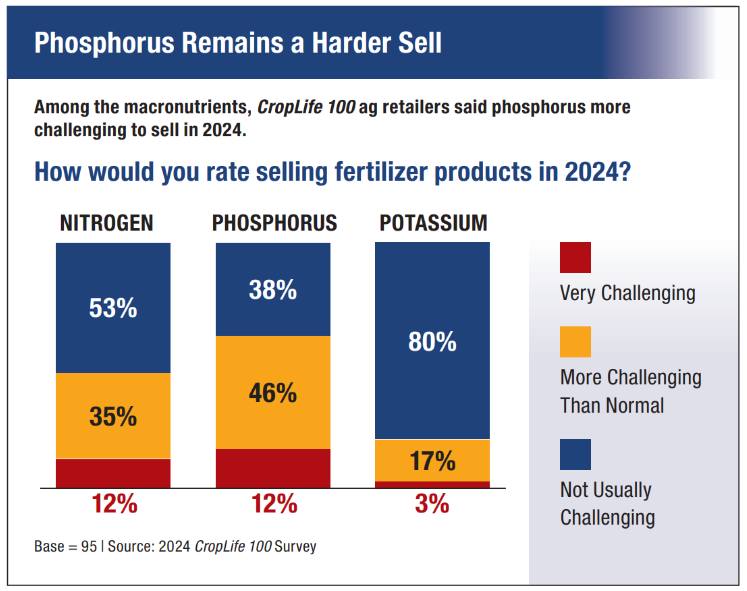 Nitrogen fertilizer showed similar trends. For these products, 53% of CropLife 100 ag retailers said sales were “not usually challenging;” 35% said they were “more challenging than usual;” and 12% said they were “very challenging.”
For phosphorus fertilizers, however, the majority of respondents – 46% – said this segment was “more challenging than usual” to sell in 2024, with 16% saying this was “very challenging.” This was probably due in part to prices for this segment not declining as quickly as those for nitrogen and potassium during the year. The remaining 38% didn’t see challenges selling phosphorus to their grower-customers.
 Going into the 2025 growing season, ag retailers are hopeful that the fertilizer category will experience a turnaround of sorts. As Nutrien’s Clayton explains: “The good news for 2025 is that the crop this year was bigger, so there was a lot of nutrient removal from soils during 2024. So, what we are seeing so far is growers are not pulling back on fertilizer applications. The good growers are saying ‘yield is going to be way more important to me in 2025 than they were in 2024. I can’t have low commodity prices times a low yield, so I have to keep more fertilizer applications strong.’”
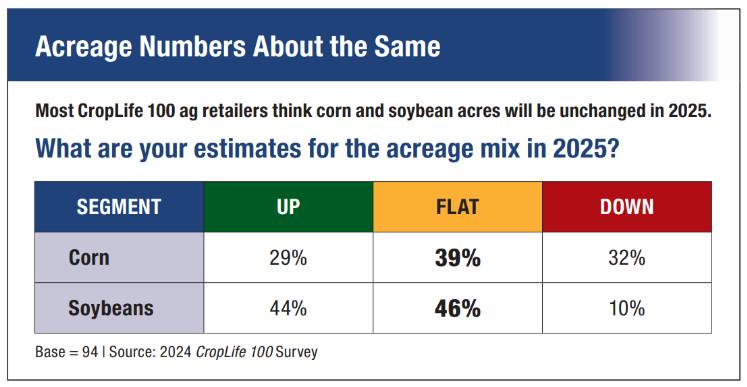
In terms of acreage numbers for next year, CropLife 100 ag retailers expect corn/soybeans percentages to remain fairly constant from 2024. For corn, 39% foresee the same amount of corn plantings next year. For soybeans, 46% predict similar acreage numbers for 2025.
Subscribe Today For
