

Soybean plants require approximately four to six pounds of nitrogen to produce a single bushel. While some nitrogen comes from the soil and the mineralization of organic matter, much of the crop’s supply depends on the relationship between soybean roots and rhizobia.
These beneficial bacteria form nodules on the soybean roots, where they convert atmospheric nitrogen into a form the plant can use. Inoculation places rhizobia with the seed at planting, positioning the bacteria to interact with the developing root system from the start. While inoculation itself is not new, advances in inoculant technology are improving both how rhizobia are delivered and how effectively the plant can use the nitrogen they provide.
“Inoculants have been around for a long time, and the perception a lot of people have is that rhizobia is rhizobia—it doesn’t matter which ones you have or whose you buy,” says Kurt Seevers, Technical Development Manager at Verdesian Life Sciences. “But the advances we’ve made with inoculants over the last several years are centered primarily on what we pair with the rhizobia, and how those additions can enhance what the bacteria does for the plant.”
But with rhizobia already present in soybean fields, why inoculate?
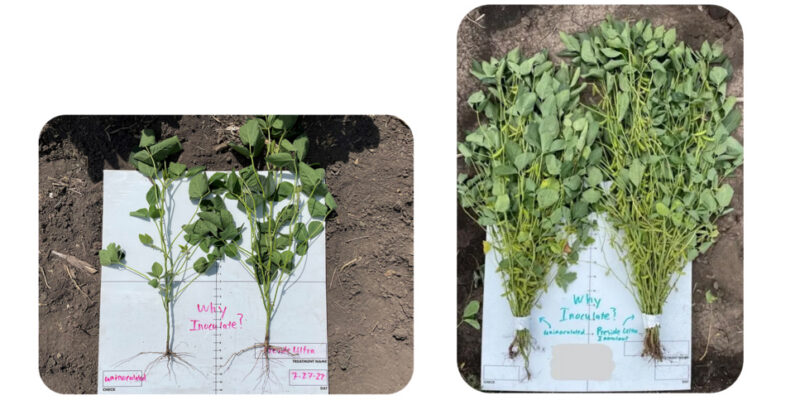
Why Background Rhizobia Aren’t Always Enough
A history of soybean production doesn’t guarantee an adequate population of effective rhizobia the next time soybeans are planted.
When a soybean plant reaches the end of its life cycle, the rhizobia that lived within its nodules return to the soil, where they must compete for resources and can become scattered throughout the soil profile. In a typical corn-soybean rotation, Seevers says those bacteria may go through Although they retain the ability to fix nitrogen, that extended period without a soybean host can reduce how effectively they perform when soybeans return to the field.
Inoculation, by contrast, places a concentrated population of effective rhizobia with the seed, where the bacteria can interact with the developing root system.
Environmental factors can add further uncertainty. Prolonged flooding, extreme temperatures, and soil pH can affect the survival and performance of background rhizobia. For retailers, the question isn’t simply whether rhizobia are in the field, but whether effective rhizobia are available where and when the crop needs them.
What Makes an Effective Inoculant?
The presence of rhizobia—or even nodules—doesn’t tell the whole story. “Nodule number and size can indicate the success of inoculation,” Seevers says, “but you also need to assess the nodules for activity. They’re supposed to be red inside. If they’re not red, they’re not producing nitrogen.”
For Verdesian, that means focusing both on the number of rhizobia delivered at planting, and on consistent performance. Preside® Ultra is a multi-strain soybean inoculant that delivers up to two times more rhizobia per seed than other soybean inoculants. Its multiple strains are designed to provide greater consistency across varying field conditions.
Preside® Ultra also incorporates Verdesian’s proprietary Take Off® technology, which accelerates nutrient acquisition and utilization within the plant. As the seed takes up water during germination, Take Off® moves into the seed, helping the developing plant utilize nitrogen from its seed reserves before rhizobia becomes a significant source of nitrogen.
From Establishment to Yield
That early support can carry through crop establishment and development, with Preside® Ultra delivering 20% faster establishment and up to 65% more nodule mass to support nitrogen-fixing capacity and faster canopy closure. “When you have more plants in the field because of improved stand, you’re getting more value from the seed, but you also have more plants out there to produce seed,” Seevers says.
Growers may see darker green plants early in the season, while effective nodulation helps support the crop’s nitrogen needs as it develops. At harvest, Preside® Ultra delivered a 1.9-bushel-per-acre yield advantage over untreated soybeans.

Starting the Season Right
Many management decisions can be adjusted as crop and field conditions change throughout the season, but inoculation is different. “If you don’t set a plant up for success at the beginning of the year, you can’t go back and redo it unless you replant the crop, and that gets expensive,” Seevers says. “There’s no such thing as a post-emergence inoculant. You must have what you need on the seed from the very beginning, or you’re going to miss out,”
For growers planning for the season ahead, inoculation is one decision that pays to get right from the start.
Learn more about Preside® Ultra.
Data on file. Results may vary based on local environmental conditions. Important: Always read and follow label use directions. TM/® are the property of Verdesian Life Sciences. © 2026 Verdesian Life Sciences. All rights reserved