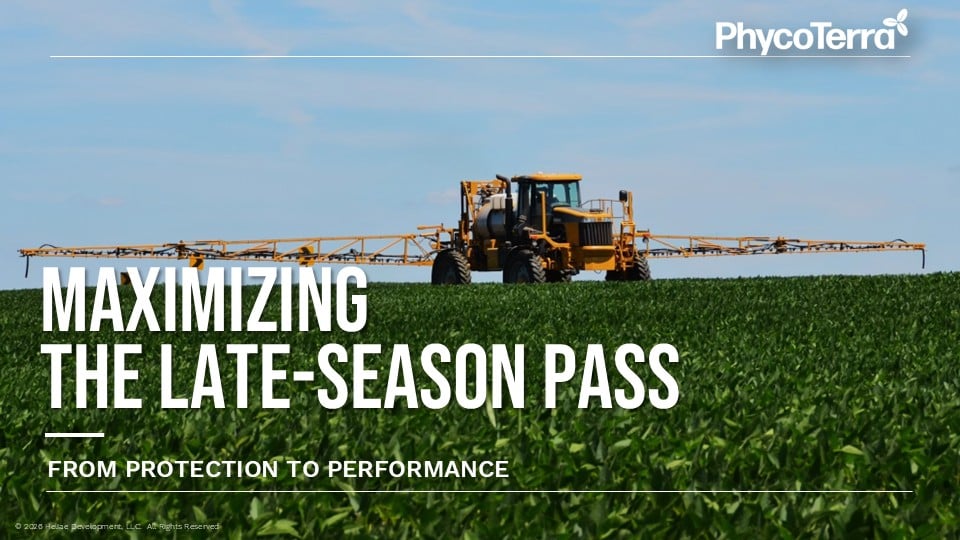
Retailers already know the late-season fungicide pass is one of the most important trips across a field. What is changing is how that pass is defined and how much value it can deliver.

The late-season pass is already planned, but the real value comes from what is added to it.
“We’ve traditionally referred to it as the fungicide pass,” says Dustin Blunier, director of agronomy at PhycoTerra®. “But there’s much more in that pass that determines not just whether it works, but how well it performs.”
A Fragile, High-Value Window
Late-season management sits in a narrow window where yield is still being built. At early reproductive stages, roughly 40 percent of yield potential is still unresolved.
That potential is exposed to multiple stressors at once. Heat, water variability, disease pressure, and energy limitations all converge during grain fill. The result is a delicate period where small management decisions can swing final outcomes.
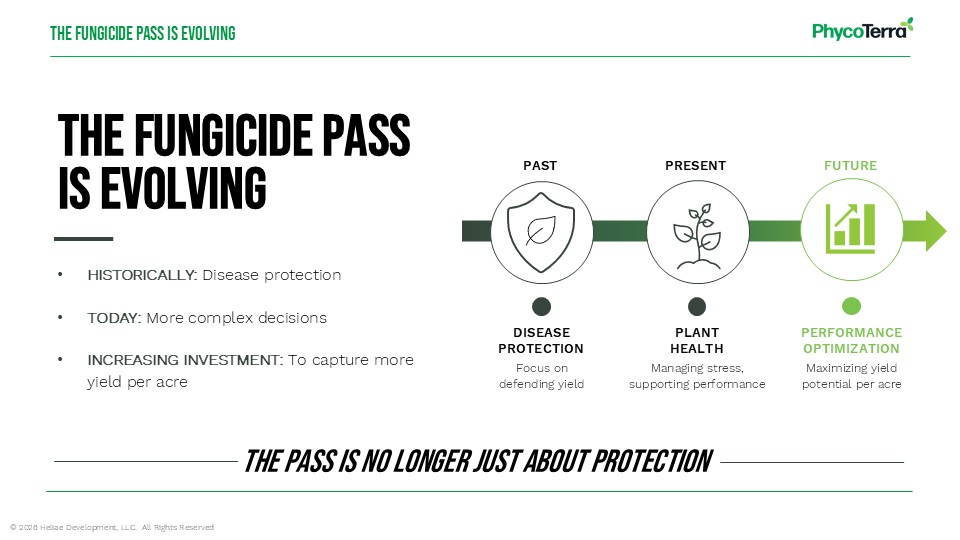
Blunier frames this as a shift in mindset. The fungicide pass started as a defensive move. Today, it is a performance window.
“We’re not at that stage because we didn’t do anything,” he says. “We did management practices early in the season. Now we want to keep that momentum going.”
Four Inputs, One System
Retailers are already bundling products into this pass. The difference now is how those decisions are made.
Blunier breaks the pass into four core input categories: fungicides, insecticides, foliar nutrition, and biostimulants. Each plays a role, but none of them is universally required.
Fungicides remain foundational. They protect plant health and preserve yield potential. But they are not enough on their own.
“Performance is bigger than just protection,” Blunier emphasizes.
Insecticides require a more disciplined approach. Blanket applications erode ROI and can disrupt beneficial insect populations.
“We don’t want to go out there and just throw insecticides out just to do it,” says Wade Walters, a fourth-generation farmer in Shickley, Nebraska. “We want to make sure that we have the proper threshold to treat.”

Foliar nutrition brings another lever, but only when it is targeted. Tissue testing is becoming a key decision tool.
“We’ll go out and pull some tissue tests a couple of weeks prior to what we think our fungicide window is going to be,” explains Walters. “If there’s a deficiency, we’ll throw a foliar product with it.”
Biostimulants offer upsides but introduce variability. Their effectiveness depends on timing, environmental conditions, and whether the plant can respond to the signal being triggered.
“Understanding that specific mode of action and what going to be triggered is very important,” Blunier notes.
The consistent theme across all four inputs is prescription. Retailers who treat the pass as a fixed recipe leave value on the table.
The Missing Layer, the Leaf Environment
Beyond those four inputs, there’s a fifth factor that shifts the discussion further. It moves outside the plant itself.
That factor is the phyllosphere, the microbial environment on the leaf surface.
In a single square centimeter of leaf area, there can be roughly 10 million bacteria and 1 million fungi. These organisms influence plant response to stress, nutrient efficiency, and disease susceptibility.
“The phyllosphere becomes very important, and it’s very dynamic,” Blunier says.
This is where PhycoTerra positions its product, FX – Foliar Treatment. Applied directly to the crop, it delivers a carbon-rich food source designed to feed the leaf microbiome and increase microbial activity on the plant surface.
Blunier explains the goal clearly. “Don’t just protect the plant. Enhance the environment it operates in as well,” he says.
The concept is simple, but the implications are broader. A more active leaf microbiome supports plant regulation processes like photosynthesis and respiration, helps the plant respond to stress, and creates a more competitive surface that limits pathogen establishment.
That shifts the focus from treating symptoms to influencing the system around the plant.
Precision Over Packages
On-farm, Walters approaches the late-season pass as a continuous learning system. New products are tested in small blocks and scaled only after proving value.
“Maybe in year one, we try 10 or 20 acres of a product,” he explains. “If it proves itself out, it’ll be across our whole operation in a couple of years.”
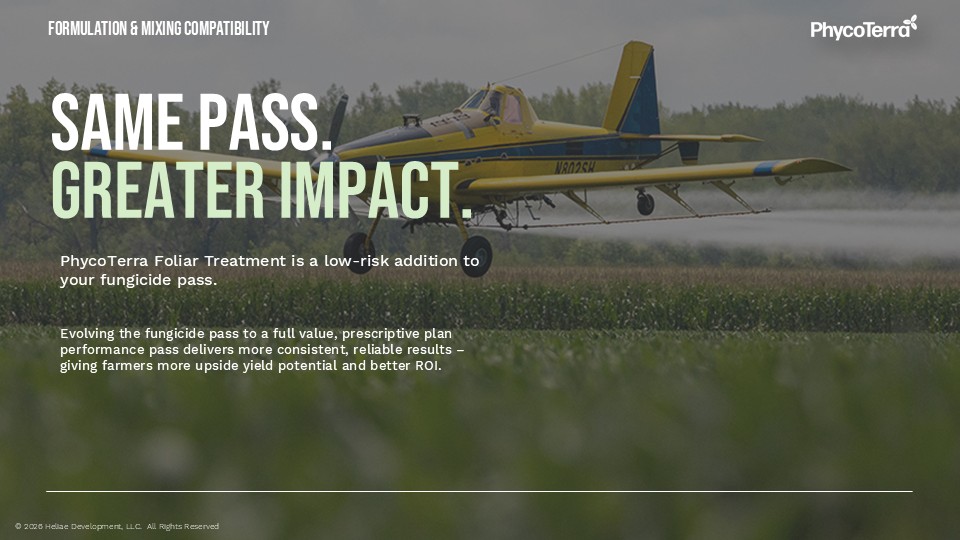
That discipline extends to every aspect of the pass. Mixing compatibility, application timing, and coverage all matter.
“We want to make sure that everything mixes together well,” Walters says. “And that we’re not going to hurt anything.”
Timing is especially critical. The same product can perform very differently depending on growth stage and environmental conditions.
Retail Opportunity
For retailers, the implications are clear. The late-season pass is no longer a single product decision. It is a systems conversation.
Blunier emphasizes that this creates a more valuable advisory role.
“If you can target and prescribe across all of these elements, you can maximize the predictability and the performance,” he says.
That means shifting conversations away from product bundles and toward field-specific needs. It also means helping growers understand that consistency comes from stacking small advantages, not relying on one input to carry the pass.
The acres are already committed. The application is already planned. The cost of the trip is already absorbed.
Retailers who treat the pass as a platform for performance, not just protection, have a clear path to differentiate.
If you missed the live broadcast of this webinar, “Maximizing the Late-Season Pass: Protecting and Enhancing Crop Performance” you can view the archived version online here or visit CropLife.com/webinars and check it out today.