Every application trip across the field carries a cost and an opportunity. The question is how much value that pass can deliver. New data around integrating fungicide into sidedress applications points to a clear answer. Done right, it can shift disease management from reactive to proactive while improving overall crop performance.

According to Adam Byrne, technical service manager at FMC, retailers should rethink how and when they position fungicides in corn programs.
“We’re not just talking about disease control,” Byrne says. “We’re seeing crop development benefits, improved water and nutrient use, and flexibility in how growers manage disease pressure.”
A Different Kind of Fungicide Profile
At the center of the discussion is flutriafol, the active ingredient in FMC’s Xyway® fungicide. Its value starts with how it behaves in the plant.
Flutriafol combines high systemic movement with long residual control. That combination is unusual, and it changes how fungicides can be used. Instead of relying solely on foliar applications later in the season, growers can apply it early and maintain activity into key reproductive stages.
“When we looked at residue levels at R3 from an at-plant application, we were still seeing several parts per million in the leaf tissue,” Byrne explains. “That’s well above what’s needed for disease control.”
This mobility allows the plant to continuously take up the active ingredient through the roots as it develops. The result is protection that extends well beyond what a single foliar pass can typically provide.
Plant Health Is Part of the Equation
Fungicides are often viewed as a reactive input. Byrne’s data suggests that view is incomplete.
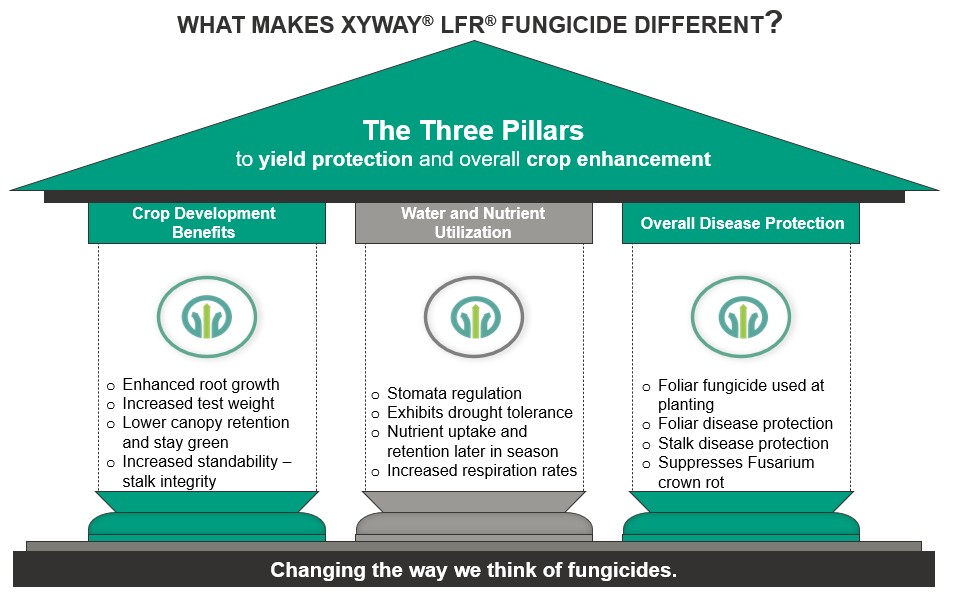
“We started seeing differences in how the crop looked before we even focused on disease,” he notes. “Broader leaves, darker color, stronger canopy.”
University trials backed that up. Plants treated with Xyway consistently showed larger root systems, more branching, and improved root mass. Those changes have direct implications for water and nutrient uptake.
In controlled studies, treated plants demonstrated higher hydraulic conductivity, meaning they moved water more efficiently through the plant. Tissue analysis reinforced the trend, with measurable increases in nitrogen, phosphorus, potassium, and sulfur.
“These systems are connected,” says Byrne. “When you keep the crown and stalk healthier, you’re improving the plant’s ability to move water and nutrients. That feeds into everything else you see above ground.”
Extending the Window on Disease
For retailers managing customer expectations around foliar fungicides, timing remains a challenge. A single R1 application often delivers about three weeks of strong protection, while corn still has a long grain-fill period ahead.
“If you make a prescriptive application at tassel, you’re only halfway through grain fill when that protection starts to wear off,” Byrne emphasizes.
That reality makes early-season fungicide placement more valuable. Xyway does not eliminate the need for foliar applications, but it changes the timing conversation.
With hard-to-control diseases, like tar spot and southern rust, early applications help delay infection and provide flexibility. Byrne describes multiple cases where Xyway extended the response window.
“It bought us about seven to ten days,” he notes. “That doesn’t sound like much, but when you’re trying to time a foliar application, it’s a big advantage.”
In replicated strip trials, two-pass programs consistently delivered the highest yields. But even standalone Xyway treatments improved results under severe disease pressure by maintaining plant health longer into the season.
Why Sidedress Makes Sense
The practical question for retailers is how to implement this approach efficiently. That is where sidedress applications come in.
Adding a fungicide to a pass that already includes nitrogen is operationally simple. It also aligns with the goal of maximizing return on each field visit.
“Why not add it to a pass you’re already making?” Byrne says. “It plays well with most fertility programs, and it gives you those plant health benefits early.”
Field research supports the approach. Across multiple university trials, sidedress applications delivered yield gains comparable to traditional at-plant placement. In Purdue-led studies, the average response was about seven to eight bushels per acre, with no meaningful difference between placement methods.
“That was one of the big takeaways,” Byrne emphasizes. “We didn’t see a significant yield difference between two by two at planting and sidedress applications. That opens the door for a lot more growers.”
Even placement farther from the row showed consistent performance, easing concerns about precision during sidedress operations.
In grower demonstrations, results varied depending on environment and disease pressure, but the upside was clear. Byrne points to cases with gains exceeding 30 bushels per acre, even when disease pressure was high.
“You’re going to see variability,” he says. “But the pattern is consistent. The system is doing more than one job.”
A Tool That Expands Decision Options
For retailers advising growers, the biggest shift may be strategic rather than operational.
Traditional fungicide programs rely on fixed timings and assumptions about disease risk. Xyway introduces flexibility. It allows growers to delay foliar decisions, respond to actual field conditions, and avoid unnecessary applications in low-pressure years.
“It lets you react instead of guess,” Byrne says.
He is careful to position it as part of a broader, integrated approach rather than a replacement for foliar fungicides.
“I wouldn’t go in assuming you’ll skip a foliar pass,” Byrne says. “But it gives you the ability to make that decision based on what you’re seeing in the field.”
For retailers, that flexibility can strengthen recommendations and build trust. It shifts the conversation from product placement to outcome management.

Making Each Pass Count
Sidedress has always been a logistical necessity. The emerging data suggests it can also be a strategic lever.
By integrating fungicide into that pass, retailers can help growers address disease earlier, improve plant efficiency, and extend the effectiveness of later interventions.
“The only predictable thing in agriculture is unpredictability,” Byrne concludes. “What we’re trying to do is give growers tools that help them adapt.”
For retailers looking to differentiate their agronomic approach, that combination of early protection, plant health, and decision flexibility is difficult to ignore.

If you missed the live broadcast of this webinar, ‘From Reactive to Proactive: Disease management Gets New Application’ you can view the archived version online here or visit CropLife.com/webinars and check it out today.