
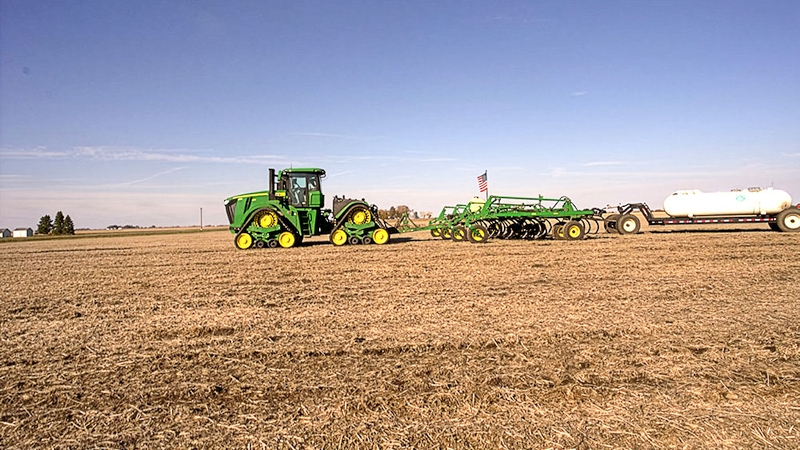
As spring applications approach, many growers focus on timing, placement, and rate. Andrew Luzum, nitrogen stabilizer strategic account manager at Corteva Agriscience covering Iowa and Illinois, says one priority continues to stand out. Keep nitrogen in the ammonium form long enough for the crop to use it.
“Even when you apply nitrogen in the spring, it is key to use a product like N-Serve® or Instinct NXTGEN® to keep that nitrogen in the ammonium form as long as possible,” Luzum says. Soil bacteria become more active as temperatures rise. Once that activity ramps up, the risk of early conversion and loss increases.
Corn compounds this challenge. Plants do not take up large amounts of nitrogen until mid-May or later. Luzum puts it plainly. “When you think about early applications, we want to have that nitrogen there when the corn can use it. We do not want to lose it.”
How the Stabilizers Work
Both N-Serve and Instinct NXTGEN nitrogen stabilizers target nitrifying bacteria. Luzum explains the process this way. “We affect the Nitrosomonas bacteria, which convert ammonium to nitrite. We put the bacteria in a form of stasis. We don’t kill it, but rather keep it feeding on the food source, which is the ammonium.” That slowdown gives growers more time.
The products have a long track record. “N-Serve is 50 this year. We have been doing this for 50 years now, which is pretty crazy,” he says. That longevity is part of why the technologies are widely adopted throughout the Midwest.
Data Behind the Performance
Stabilizers are often evaluated on two metrics. How effectively they keep nitrogen in the ammonium form. How consistently they protect yield potential. Luzum points to both internal and university results.
“We are always doing local field trials, but we have also analyzed a lot of data from Purdue University over the last few years,” he says. Many of those trials reflect how growers apply nitrogen today. “A lot of growers are now split-applying, versus the one-pass approach from 20 years ago. We have been split-applying nitrogen with Purdue, and with Instinct NXTGEN, I have seen some really nice yield results.”
Corteva’s latest annual summary supports those findings. “We just announced our 2025 yield summary from all our field trials across the Midwest,” Luzum says. “When you look at spring applications last year, we averaged 8 bu/A more. Side dress was 5.” The numbers reinforce the value of keeping nitrogen in the ammonium form during early spring conditions.
The Case for Spring Stabilization
Many growers already stabilize fall nitrogen. Luzum says that mindset should extend into spring. “If you are using a stabilizer in the fall, you are actually using it for the spring. When soils warm up, bacteria become more active.” The same logic applies when nitrogen is applied close to planting. Protecting it during the most vulnerable period helps maintain availability through early vegetative growth.
The agronomy remains simple. Nitrogen is valuable and mobile, and spring weather adds unpredictability. Stabilizers give growers more control without altering the application plan. For Luzum, that is the practical takeaway. Keeping nitrogen where the crop can reach it is the fastest way to protect investment and yield.