Biologicals Move from Fringe to Functional
For many Midwest growers, biological crop protection still carries an organic label. That perception overlooks how widely biological tools are already used in conventional corn and soybean 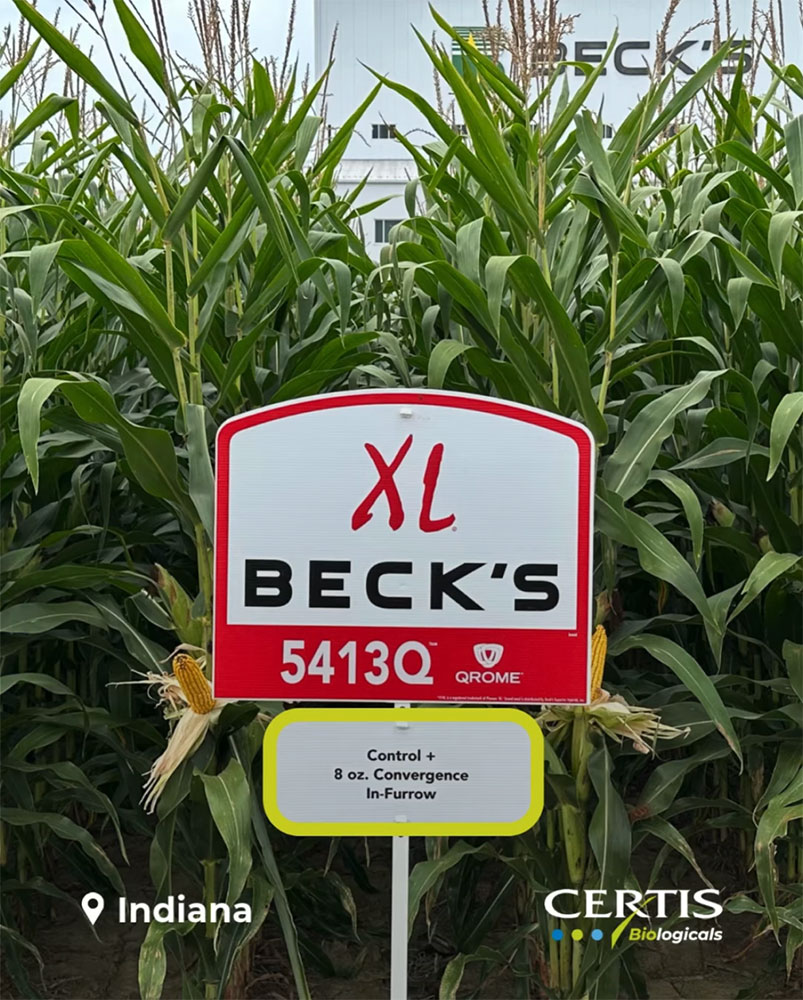 systems, particularly in seed treatments and soil applications. In practice, biologicals are less an alternative and more a supporting layer within today’s row crop programs.
“There are biological products throughout the row crop production process,” says Greg Rogers, director of technical marketing and communications at Certis Biologicals. “Growers are using them now. They just don’t always recognize where they show up or what they’re contributing.”
Seed treatments are often the first point of entry. Rogers points out that biological components have been part of mainstream seed treatment programs for years. From there, soil-applied biologicals tend to deliver the most consistent returns.
“Soil is where biologicals really find their home,” Rogers says. “That’s where you see the strongest, most repeatable performance.”
A Practical Role in Resistance Management
In specialty crops, biologicals have long played a role alongside synthetics. Row crop systems are now moving in the same direction as available traditional chemistries narrow, and resistance risk grows.
“We’re running out of actives,” Rogers says. “A lot of the newer products are single-site modes of action, and those are inherently more vulnerable to resistance.”
Row crops face less pressure than specialty systems, where crop protection applications can exceed a dozen sprays per season. Even so, repeated exposure to the same modes of action adds up. According to Rogers, biologicals help by introducing multi-site activity into the program.
“The majority of biologicals on the market are multi-site,” he says. “They add a layer of protection that helps slow resistance development against those single-site products.”
The concept is familiar. Rogers points to Bt traits as a reminder that resistance can emerge even when pressure appears manageable. Biologicals give growers another diversification tool without forcing major changes to their program structure.
Rethinking ROI Beyond Yield Alone
In corn and soybeans, yield remains the benchmark for input decisions. Rogers doesn’t dispute that. He suggests that the value of biologicals often shows up earlier and more quietly.

Greg Rogers
“A lot of what biologicals buy you is insurance,” Rogers says. “Cold, wet springs or less-than-ideal soils are where they really earn their keep.”
Biologicals support early stand establishment, root development, and nutrient uptake. That translates into more uniform emergence and fewer replant decisions, outcomes that reduce risk even if they don’t always register as a yield bump at harvest.
“You like to see green corn coming out of the ground and looking healthy,” Rogers says. “That confidence matters. It affects every downstream decision you make.”
Certis products, such as its Double Nickel® biofungicide formulations, also suppress soilborne diseases and nematode activity by forming a protective, symbiotic relationship with the plant root. These benefits compound during marginal seasons, where small early advantages can prevent larger losses later.
Manufacturing Quality Determines Consistency
Performance reliability remains a core concern for large-acre growers. Rogers says skepticism toward biologicals is often tied to inconsistent results, which usually stem from manufacturing and formulation.
“Fermenting biologicals is almost as much an art as a science,” he says. “Getting the same dependable product every time takes experience.”
Certis has been fermenting microbial products for more than six decades. Rogers emphasizes that production history alone is not enough. Field testing, formulation stability, tank mix compatibility, and quality control all determine whether a biological product holds up in real-world use.
“We test biologicals the same way conventional products are tested,” Rogers says. “If we’re putting an EPA Section 3 label on it, we’re saying this is a crop protection product that delivers.”
He draws a sharp distinction between registered biological pesticides and loosely formulated biostimulants.
“There are products out there with 10 or 12 organisms in a jug,” he says. “Half of them cancel each other out, and none of them are at an effective level.”
Compatibility matters. Biologicals interact, and not all combinations belong together. “You can’t just throw everything in and expect it to work,” concludes Rogers. “You have to design the formulation intentionally.”