
Insect pressure doesn’t end at harvest. A proactive grain protection protocol can help growers preserve quality, reduce losses, and protect the value of stored grain.

For growers managing increasingly tight margins, maximizing the value of every bushel is critical. While much of the focus during the growing season is on protecting yield in the field, grain remains vulnerable after harvest. Once it enters storage, insects can continue to reduce quality and dry matter—potentially eroding the financial benefit of holding grain for a stronger market.
That’s why Central Life Sciences advocates moving away from a “see bugs, treat bugs” mindset and toward a proactive grain protection protocol. In a recent webinar, “Getting More for What’s Stored: The Hidden Cost of Stored-Grain Insects,” experts from Central Life Sciences, John Mays, Senior Director, Specialty Ag, and Dr. Johnny Wilson, Technical Services Manager, outlined how to implement a grain protection protocol and tools to aid success.

“You can’t afford to lose 10, 15, 20 percent of your grain when you’re storing it to try to better your profitability through marketing and give yourself some time. You can’t afford to lose, you know, 10-20% of your crop that’s being stored because of bug damage,” Mays says. Unfortunately, we have seen this happen all too often.
USDA says that up to 5-10% of the stored wheat crop is damaged by insects once it goes into the bin. Untreated corn can experience up to 3.1% dry matter loss in as little as 60 days and untreated rice can experience up to 5.2% dry matter loss in 120 days. We sometimes forget that the clock is still ticking against us when we get the crop out of the field, and it goes into storage.
It’s difficult to detect damage in a grain bin until damage is already underway. Internal feeders, including rice weevils, granary weevils, and lesser grain borers, can develop inside kernels, consuming dry matter before an infestation becomes readily visible.
The resulting losses can go beyond shrink. Insect activity can contribute to dockage and rejected loads, while creating additional transportation, handling, and treatment costs.
The risk also isn’t limited to warmer regions. Cooler temperatures may slow insect development, but they do not eliminate the threat. Long storage periods provide opportunities for populations to establish and multiply.
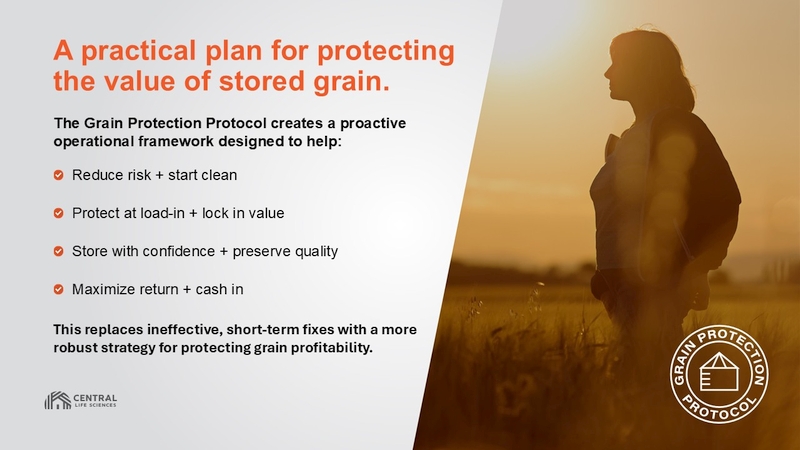
Start with a Clean Storage Environment
An effective protection program begins before grain enters the bin. Removing residual grain and other potential insect harborages from bins, conveying equipment, and surrounding areas helps reduce existing populations, Wilson says.
The loading process provides another opportunity for intervention. Insects can enter with harvested grain or through harvesting, conveying, and transportation equipment. Once grain is in storage, vents, aeration systems, and other openings can provide additional pathways for reinfestation.
Matching Products to the Problem
Central Life Sciences’ approach emphasizes selecting products according to the specific risk rather than treating every storage situation the same.
“The three main opportunities for infestation are existing harbor points where we’ve got a population of insects already present in our storage, conveying and processing equipment, and insects coming in with new grain,” Wilson says. “Additionally, during that storage life cycle, we potentially have insects coming in from the outside environment. How do we make informed decisions based on those things? How do we use products in these different scenarios? So, I like to classify our products into three different buckets. We have the preventative side, and we have the reactionary side. And then we have the full control side.”
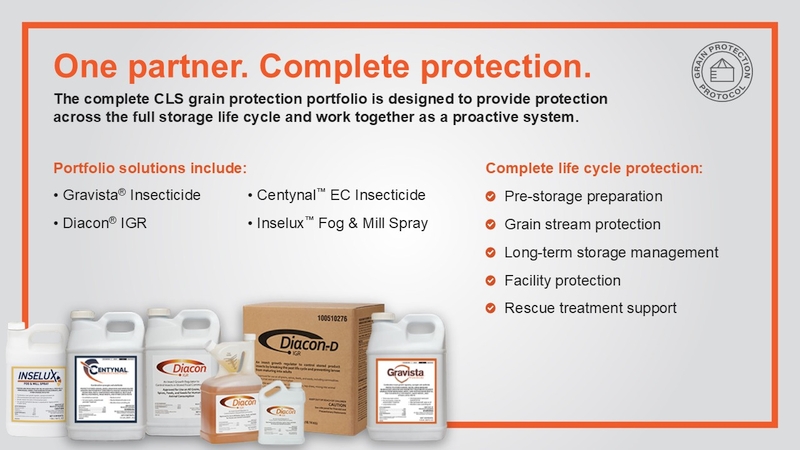
Diacon® IGR and Diacon®-D are used preventatively. The insect growth regulator approach is designed to interrupt insect development and help prevent populations from progressing. Diacon® IGR has a long history in stored commodity protection, dating to Central Life Sciences’ early work with IGR technology.
When immediate adult-insect control is the priority, Centynal™ is positioned as a reactionary option. Wilson describes its combination of an adulticide and synergist as a way to provide rapid knockdown when live insects are present, including situations involving grain that is approaching delivery.
For situations requiring both adult control and longer-term population management, Gravista® Insecticide and Gravista®-D provide a combination approach. According to Wilson, Gravista® Insecticide combines an adulticide, an insect growth regulator, and a synergist, giving operators both immediate control and longer-term protection. The dry formulation can also be used for certain horizontal surfaces, while the liquid formulation can be incorporated into other treatment areas.
Lastly, Inselux™ Fog & Mill Spray is a broad-spectrum insecticide that provides a longer residual effect. Rather than treating the grain itself, it can be used to address environmental areas and potential insect entry points. Wilson specifically highlights applications around headspace, vents, and aeration systems, as well as broader storage and processing environments.
Protecting the Payoff
By combining a clean starting environment with appropriate preventative, reactionary, and full-control products, growers and grain handlers can address insect pressure before it becomes an expensive problem.
Ultimately, grain protection is about preserving the value of the crop until it reaches the market. A proactive approach can help reduce avoidable dry-matter loss, protect quality, and minimize costly surprises at delivery—keeping more of the value of every bushel where it belongs.
For more information and to create your own Grain Protection Protocol, visit: GrainProtection.com

If you missed the live broadcast of this webinar, “Getting More for What’s Stored: How Proactive Grain Protection Supports Grower Profitability” you can view the archived version online here or visit CropLife.com/webinars and check it out today.