
Fighting Soybean’s Costliest Underground Threats
Soybean Cyst Nematode (SCN) and Sudden Death Syndrome (SDS) rarely announce themselves early. That silence is the problem.
SCN remains the leading cause of soybean yield loss in the United States, quietly stripping an estimated 100 million bushels every year. SDS adds roughly another 35 million bushels of loss annually. Combined, those numbers represent more than $1.5 billion in lost value each season.

Nick Tinsley
“These are serious economic issues,” says Nick Tinsley, a seed treatment technical field representative at BASF. “A lot of that loss is happening without obvious above-ground symptoms.”
That hidden yield drag was the focus of a recent BASF CropLife webinar led by Tinsley, who works across the Eastern Corn Belt supporting research, field trials, and grower decisions tied to seed-applied technologies. His message is direct. “If growers are not actively managing SCN first, they are already behind”.
The Yield Thief Hiding in Plain Soil
SCN is not new, but it remains dangerously underestimated. It is a microscopic roundworm that infects soybean roots and disrupts nutrient uptake, nodulation, and overall plant vigor.
“It’s been estimated you can lose 30% of your yield without seeing any symptoms at all,” Tinsley says. “That’s pretty scary when you realize how easy to miss the presence of SCN causing yield loss.”
BASF has taken thousands of soil samples across soybean-growing regions to measure SCN pressure. Only about one-third of those samples tested at low or undetectable levels. More than half exceeded the economic threshold, defined as 500 eggs per half cup of soil.
Once established, SCN populations cannot be eliminated. A single female cyst can hold hundreds of eggs, allowing populations to build rapidly. Those infections also weaken root tissue, creating entry points for additional pathogens.
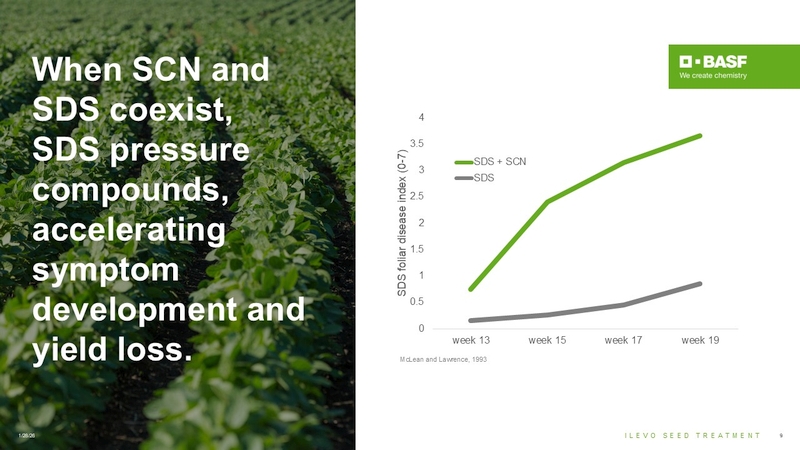
“SCN has a tendency to make everything else worse,” Tinsley cautions. “It weakens the root system and opens the door for SDS, seedling diseases, and red crown rot.”6
Why SDS Shows Up Late
SDS can be confusing because the most visible damage appears in the canopy, not the roots. The pathogen responsible for SDS infects soybean roots shortly after germination. It never moves into above-ground tissue.
Even more deceiving is the yield loss that occurs without visible leaf damage. Root rot alone can significantly reduce yield.
“You can have a very healthy-looking canopy,” Tinsley notes, “but still be losing yield because of what’s happening below ground.”
What shows up later in the season is toxin damage.
“The fungus produces toxins in the root system,” Tinsley explains. “When we get late-summer rainfall, the plant moves those toxins upward, and that’s when you see the foliar symptoms.”
Leaf tissue turns yellow and brown while veins remain green, while leaflets drop off. Symptoms usually appear in compacted or poorly drained areas, often spreading outward.
Managing What You Can’t See
Scouting for SCN requires soil sampling, not visual observation. Tinsley recommends sampling in the fall or ahead of planting, not during the growing season, when nematode populations are still building.
“You can underestimate your risk if you sample too early,” he cautions.
A typical approach involves taking 15 to 20 soil cores per 20-acre section, then combining them into a single sample. Fields can also be divided by management zones or targeted problem areas.
For SDS, historical field records matter. The pathogen moves slowly and persists in soil for years. Fields with past symptoms are strong indicators of future risk, even if visible damage has not appeared recently.
The Limits of Native Genetic Resistance
Most soybean varieties today rely on the PI 88788 source of SCN resistance. Which has been widely deployed since the early 1990s. Over time, its effectiveness has declined.
“In 1999, PI 88788 was about 90 percent effective,” Tinsley says. “Today we’re looking at something more like 30 to 70 percent.”1
That reduction translates into a measurable yield gap, even in varieties labeled as SCN-resistant. Genetic resistance remains essential, but it is no longer sufficient on its own.
SDS-tolerant varieties pose a different challenge. Many limit foliar symptoms but do not prevent root rot.
“There are no varieties I would call immune,” Tinsley notes. “You still need protection at the root level.”
Seed Treatment as Early Insurance
Because both SCN and SDS infect plants early in their development, seed treatment plays a critical role. ILEVO® seed treatment from BASF was developed to address both threats simultaneously.
Since its launch in 2016, ILEVO seed treatment has delivered an average yield gain of roughly 4.6 bushels per acre in trials, with positive responses in more than 80 percent of comparisons.3
In SDS trials, ILEVO seed treatment reduced root rot severity and foliar symptoms compared to standard treatments. In SCN-focused trials, it reduced egg production on roots by nearly 80 percent.4
“It has a direct negative impact on all stages of SCN,” Tinsley emphasizes. “Eggs, juveniles, females. It reduces their ability to reproduce.”
ILEVO seed treatment does cause a cosmetic halo effect on cotyledons early in the season, a light discoloration that often raises questions.
“Think of it like a mild sunburn,” Tinsley explains. “It doesn’t affect stands, roots, or yield.”
Looking ahead
Despite the scale of SCN and SDS risk, only about 10 million of the estimated 32 million at-risk soybean acres receive targeted protection today. 5 That gap suggests yield losses will continue unless management practices change.
For now, Tinsley’s guidance remains grounded in fundamentals. “Know what’s in your soil,” he concludes. “Manage SCN first. Use every tool available. A lot of yield is being lost quietly, and it doesn’t have to be.”

If you missed the live broadcast of this webinar, ‘Fighting Soybean Threats: How to Win Against SCN + SDS’ you can view the archived version online here or visit CropLife.com/webinars and check it out today.
1 Crop Protection Network. Soybean Disease Loss Estimates from the United States and Ontario, Canada 2015–2021. SCN Coalition Grower Survey, 2020.
2 BASF SCN Sampling Projects, SCNfields.com (7,752 total samples. Nov 12, 2024)
3 Based on ten years of internal and external trial data from 2011-2020 with comparison to fungicide/insecticide base, ILEVO seed treatment applied at 0.15 mg ai/seed.
4 2020 Company Sponsored Trials (IA, IL, MN, WI, MI, KS). All treatments received the same F/I Base. Mid-season assessment of soybean sudden death syndrome. ILEVO applied at 0.15 mg a/seed.
5 Context Market Research, Internal Estimates, 2024
6Exploring Sudden Death Syndrome Pathogens and SCN Connections – Research Highlight – Soybean Research & Information Network – SRIN
Always read and follow label directions. ILEVO is a registered trademark of BASF. ©2026 BASF Agricultural Solutions US LLC. All Rights Reserved