Faces of Responsible AG
At EPA, Safety Is the Goal
Scroll Down to Read
Federal regulator values voluntary ResponsibleAg program
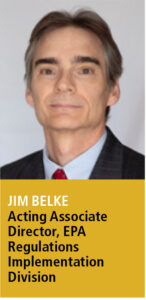
Jim Belke is no stranger to jobs that are inherently risky. As a U.S. Navy officer, he trained in the Naval
Nuclear Propulsion Program, qualifying as a chief nuclear engineer. He served on active duty for eight years, spending much of his time aboard nuclear submarines — a workplace fraught with danger. There, he learned the importance of developing and maintaining a culture of safety. “A common thread in my career has been managing risks and preventing accidents,” says Belke, who holds degrees in both electrical and civil engineering.
Belke administers the Risk Management Plan (RMP) Rule for the U.S. Environmental Protection Agency, a rule that provides part of the federal regulatory framework for fertilizer manufacturers and agricultural supply retailers.
While the safety challenges presented by anhydrous ammonia or ammonium nitrate may differ from those posed by a nuclear reactor, the same sets of safety principles apply in order to prevent catastrophe. “The agriculture industry and agricultural chemical distributors represent about 30 percent of all the facilities we regulate. That’s over 3,500 facilities,” Belke says. “We want all industry sectors we regulate to be safer. That’s the whole goal of the RMP program.”
Collaborating on safety culture
Belke, who joined EPA in 1996, says that since the inception of the RMP program, the number and severity of accidents in regulated industries has decreased overall. Many
industries have moved toward voluntarily adopting a set of common principles to improve industry-wide compliance and safety. In the agricultural supply industry, that effort is the ResponsibleAg Certification Program.
Launched in 2014, the industry-led initiative is committed to helping agribusinesses ensure compliance with environmental, health and safety (EHS) and security regulations to keep employees, customers and communities safe. The initiative offers a systematic approach to facility evaluation, recommendations for improvements and
a comprehensive collection of resources members can turn to for information and education. As RMP program coordinator, Belke sees the agriculture industry as a partner in the quest to improve safety for all. “We do a lot of work collaborating with industry groups and trade associations to promote safety and safer operations,” Belke says. “As a government regulator, I view ResponsibleAg as a great thing. We’d much rather have the industry taking ownership, finding safety issues and fixing them before we ever show up.”
“As a government regulator, I view ResponsibleAg as a great thing. We’d much rather have the industry taking ownership, finding safety issues and fixing them before we ever show up.” – Jim Belke
Audit to find, fix issues
One reason Belke likes the program is that the rigorous auditing process helps facilities find problems they may not have identified without the audit. The ResponsibleAg checklist is comprehensive and provides opportunities to find and address issues while they’re small, rather than allowing them to become big problems that increase the likelihood of an accident. Belke also commends the program for encouraging facilities to take a deep dive into safety and not shy away from finding problems during an audit. “A lot of times when you walk into a facility, you look at their most recent compliance audits and everything’s perfect,” Belke says. “Sometimes, however, those facilities are the ones that are missing problems. We’d much rather see an audit where a facility has identified problems and corrected them rather than an audit that looks perfect.”
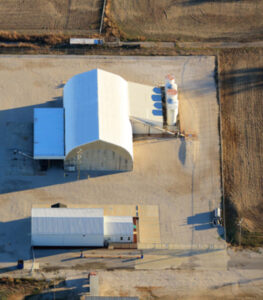
Belke toured the Ford B. West Center for Responsible Agriculture near Owensboro, Kentucky. He was impressed by the industry’s level of investment in training and education, as well as the facility’s full-scale equipment, indicating to him the industry is serious about improving safety.
Belke also has toured the one of-a-kind Ford B. West Center for Responsible Agriculture, a training facility in Owensboro, Kentucky. He was impressed with the industry’s investment in training and education. “When organizations are willing to devote that amount of resources to training and safety improvement, you know they’re serious,” he says, noting that he liked the facility’s full-scale equipment that provides training in both proper and improper facility design and compliance. “It reminds me of some of the training facilities I trained at as a naval officer.”
Going beyond checklists
While ensuring compliance with regulations is one benefit of the ResponsibleAg program, from Belke’s point of view, developing and emphasizing a culture of safety is the overarching goal. It’s an objective measured in reduced number of accidents, not only by the industry but also the program he administers.
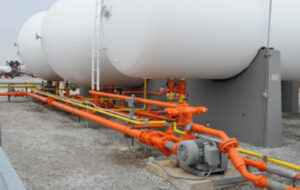
More than 3,500 agricultural retail facilities and agricultural chemical distributors are subject to the Risk Management Plan (RMP) Rule of the U.S. Environmental Protection Agency. Agriculture represents about 30 percent of the entities subject to the RMP across the U.S.
“Ultimately, are we preventing accidents from occurring? Are we making facilities and communities safer? That’s the reason for all of this,” Belke says. “ResponsibleAg has a really good checklist that covers all the applicable regulations, but it’s about more than checking a box on a list. It’s about that culture of safety. We can’t forget the big picture.” He encourages all agricultural supply facilities to participate in ResponsibleAg and even consider having an employee trained as a ResponsibleAg auditor. “It’s a great program for the industry,” he adds. To learn more about ResponsibleAg, visit http://www.ResponsibleAg.org or call 270.683.6777.