A Landus of Opportunity: How Customer Focus and Innovation Are Shaping the Cooperative’s Next Chapter
 October 5, 2026
 Growing up in a rural farm in South Dakota, Eric Heismeyer always under-stood the key role cooperatives play in agricultural life.
“Agriculture isn’t that complicated, but it’s super important to our country and to our people, to provide for their families,” says Heismeyer. “The agricultural supply chain relies on cooperatives. They play an important role in helping the industry deliver products such as grain to food, feed, and biofuel companies.”
Given his view on cooperatives, Heismeyer was drawn to the opportunity to lead within this part of the agricultural value chain. In September 2025, he formally joined Des Moines, IA-based Landus Cooperative as its new President and CEO. His positive views of the cooperative system have only strengthened in the interim.
“A big part of what excited me about Landus was the depth of agricultural talent in Iowa,” he says. “People here are committed to and driven by helping our customers succeed. Iowa is one of the best growing regions in the world, and the talent pool here is second to none.”

Eric Heismeyer
Considering the state of agriculture in 2026, adds Heismeyer, Landus’ commitment to helping customers has only increased in importance. Throughout much of this year’s growing season, growers across the country have faced myriad challenges. These have included high crop input costs, low commodity prices, supply trade disruptions caused by trade disputes and international conflicts, as well as weather extremes. All of these have taken a toll on the overall market health of agriculture across the U.S.
“In the 30 years I’ve been involved in agriculture, this is the most challenging time I’ve ever seen,” says Heismeyer. “We go through cycles in this business, and the peak of the cycle we are in right now came at the end of 2023. We are still heading toward the bottom of this cycle.”
However, Heismeyer sees the agricultural world of today undergoing much more fundamental changes than “just another cycle.”
“We are seeing profound structural challenges, and the industry is changing right in front of us,” he says. “What it costs to farm today vs. the last time we were in this kind of agricultural cycle is drastically different. Profitability is not there anymore. When you’ve had cost structures that have gone north and margins for farmers that have gone south, you have structural challenges. And it’s changing the way farmers do business, from how they use inputs to how they manage their entire operations.”
Customer Focus
With all these factors in play, Heismeyer realizes that Landus also must evolve. Staying close to customers is taking on even greater importance as day-to-day challenges on the farm have been magnified. To this end, Landus has hired more location managers and salespeople across the organization to build stronger, more consistent connections with its growers.
“You have to get closer to your customers,” he says. “If you want to know how a market such as agriculture is moving, you need to talk with your customers every single day.”
Strengthening customer communication is one of Landus’ priorities as it works to get closer to farmers and better understand what they need. In fact, Heismeyer describes the company today using a single word: Focused.
That focus starts with three fundamentals:
- People. “Organizations without humans and the talent and culture that they bring don’t succeed,” he says.
- Farmers. “They are our owners and No. 1 customers,” says Heismeyer.
- Assets. Landus operates an extensive network of grain and agronomy locations primarily across Iowa, with additional locations in Illinois, Indiana, Kansas, Minnesota, and Nebraska. Its footprint also includes the largest mechanical soybean crush facility in the U.S. in Ralston, IA, and a manufacturing facility in Boone, IA, where Landus produces nutritionals and row starters under the company’s AcreEdge brand.
“We are blessed with a really nice value chain,” says Heismeyer. “We have our farmers, and we have end markets. One of the strengths of cooperatives is that we connect farmers to end markets. That’s one of the biggest responsibilities we have.”
As Landus works to build stronger relationships with its existing customers, Heismeyer also sees the cooperative’s increased focus on customer-facing roles and local relationships to better serve younger growers as they build their agricultural businesses.
According to USDA statistics, there are approximately 300,000 farmers across the U.S. under the age of 35 (the average farmer age in total is 58). Furthermore, more than 1 million growers are considered “beginning farmers,” meaning that they have less than 10 years of experience in agriculture.
This group of newer growers represents an entirely new opportunity and challenge for cooperatives such as Landus, says Heismeyer.
“Agriculture is changing at breakneck speed, especially since the COVID years,” he says. “We have a great opportunity to work with these younger farmers and help them adapt to the market changes we are seeing across the board. And some of the newer ways they want to do business will change us, too. As they change, we at Landus will have to change with them.”
The Technology Quest
With this new group of growers getting into the mix, cooperatives such as Landus are serving multiple generations of farmers at once. Although Baby Boomers and Generation Xers still make up much of the grower community, Millennials and members of Generation Z are increasingly represented among the customer base. Naturally, says Heismeyer, one of the most profound differences among generations concerns how they use technology.
“Today, you have essentially multiple generations of farming,” he says. “And each of those generations uses technology completely differently.”
A perfect example of this generational divide regarding technology use is artificial intelligence (AI). For a few years now, ag retailers and their grower-customers have increasingly adopted new AI models into their business operations. According to Heismeyer, growers across generations have become increasingly comfortable using AI-generated information and insights to inform decisions in the field and the office.
“Overall, I believe that the Millennials and Generation Zers are adopting AI into their businesses much faster than the older generations,” he says. “But that doesn’t mean that Baby Boomers and Generation Xers aren’t using them as well.”
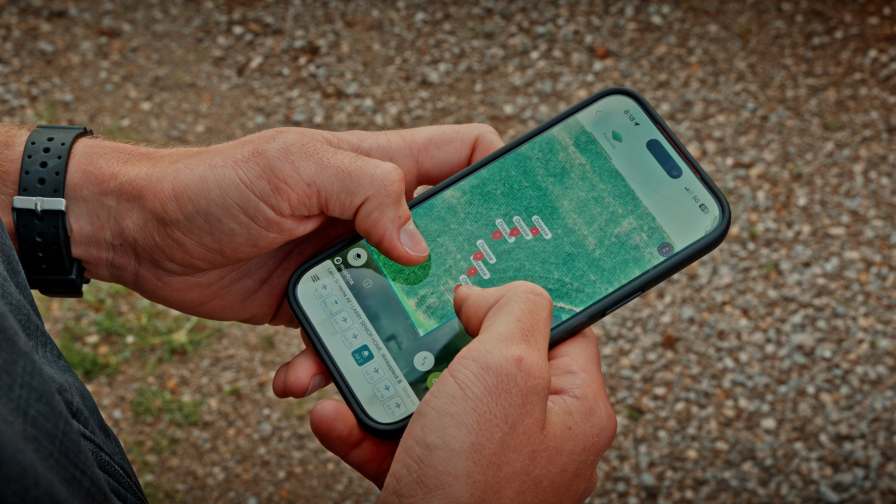
SkyScout is an advanced crop intelligence and precision agronomy platform developed by Landus Cooperative for farmers, agronomists, and crop specialists. Photo: Landus Cooperative
In terms of technology, Landus has been an early adopter of aerial imagery and advanced crop intelligence. In fact, in April 2025, the company introduced its SkyScout crop intelligence platform, which combines imagery captured by drones, fixed-wing aircraft, and satellites with AI and predictive analytics to deliver timely insights into crop health.
According to Heismeyer, this technology gives growers actionable information to help them identify plant or soil health issues earlier and make more informed in-season decisions.
“One of our major goals is to help farmers improve their yields,” he says. “This technology can help farmers with this by looking at crop fields in real time. That way, the farmers have the ability to detect diseases and do something about them quickly. It can also help with yield forecasting and potentially marketing more grain pre-harvest.”
Looking forward, Heismeyer anticipates that the many ways technology has increased the ability to farm in real time will remain a key market driver, in 2027 and beyond. Despite this, he expects that building and maintaining close relationships with growers — a guiding principle that Landus and other ag retailers were founded on — will stay paramount to the company’s long-term success.
“Farmer behavior over the past few years has completely changed,” says Heismeyer. “Technology has had an impact on making decisions such as tillage practices, hybrid selection or seed selection, and fertility and timing of application because the information needed to make these decisions is readily available much faster than ever before. But much of this business still is partnerships, with upstream and downstream partners. At the end of the day, agriculture really comes down to relationships and execution. And that’s not changing.”
Subscribe Today For
