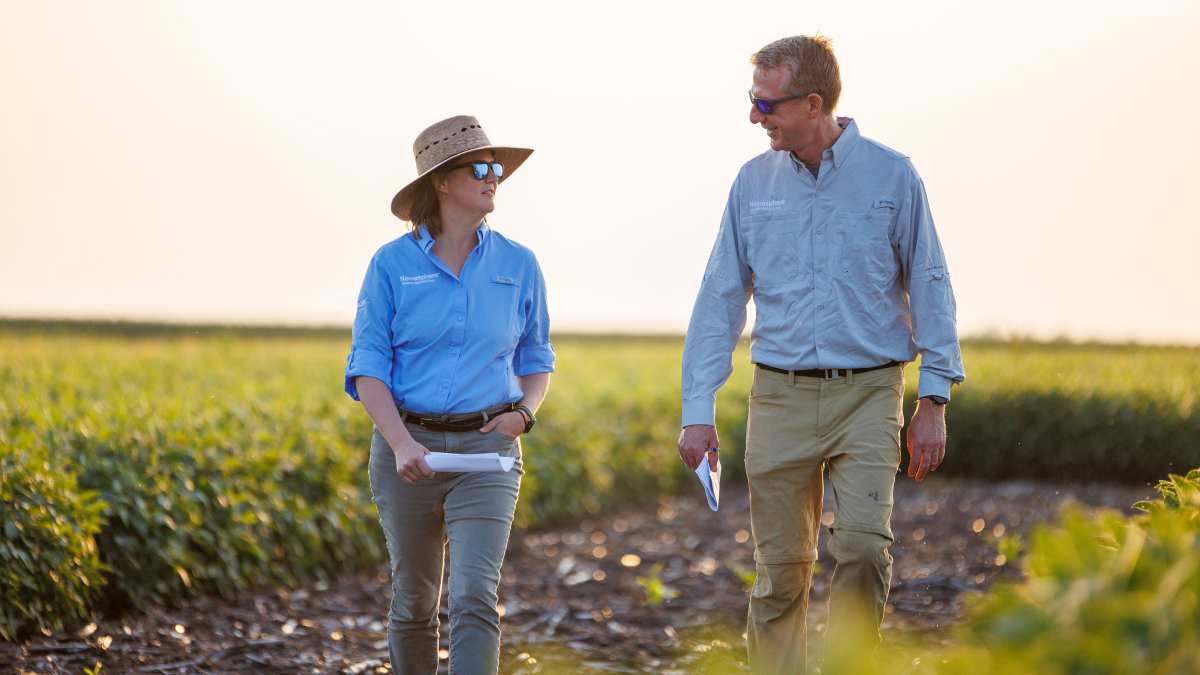

In this episode of CropLife Retail Week, CropLife Editor Eric Sfiligoj and Amy Asmus, Co-Owner of Asmus Farm Supply break down the latest USDA cost projections, the wave of ag retail consolidation, and how retailers can balance high-tech convenience with high-touch agronomy.



• Subscribe to CropLife Retail Week’s Youtube Channel
*Below is a partial and edited transcript:
Eric Sfiligoj:
Hello. Welcome to another edition of CropLife Retail. I’m Eric Sfiligoj from the CropLife Media Group, joined again by my co-host Amy Asmus from Asmus Farm Supply. Amy, welcome back.
Amy Asmus:
Thanks for having me again.
Eric Sfiligoj:
Yes, yes. And I love your logo. I can’t tell, is that a hoodie or a sweater? But it looks very nice. Very, very nice indeed.
So, Amy, I wanted to talk about a couple of things and share with our viewers. Of course, one of the topics we’ve been covering all year long has to do with costs, the prices of everything for everybody across agriculture.
Whether you’re talking about inputs, raw materials, equipment, fuel, whatever it is, I know that has been on everyone’s mind, top of mind. And I know, having just completed our CropLife 100 report, that was the number one concern for ag retailers going into 2027. As it turns out, I guess there’s a pretty good reason for that concern.
I know I ran across a report this week from our friends at USDA. They were projecting what production costs are going to look like for agriculture going into the 2027 growing season. And I have to say, some of the numbers were eye-opening, shall we say, and maybe not in a good way.
I know, in particular, they’re expecting costs to be a little higher overall from 2026 to 2027. But just calling out a few of their numbers, fertilizer is primarily going to be the highest-cost input going into next year, with costs up between 10% and 14% overall, depending on what product you’re talking about.
But they also noted that crop protection product prices are expected to be up around 10%, seed prices up around 4%, and labor up 2.7%.
So, the cost for hiring people to do things is up as well. The one price that they expect to drop, believe it or not, is interest expenses. Depending on the crop, that could drop between 1% and 4%.
Again, Amy, with these numbers coming out from USDA, I have a twofold question for you. Number one, what is this going to mean for grower customers as they move into the 2027 season? Where are they going to be looking, perhaps, to cut back, given the cost structure? And number two, what are you hearing more importantly from your folks thus far?
Amy Asmus:
So, it’s going to be an interesting year for the growers and for the retailers because, on top of prices going up, margins are being really constricted for retailers and for growers.
And so, in a low-margin year and a high-input year, things are going to be talked about, things are going to be analyzed, and business plans are going to become just as important as agronomic plans, I think, for the grower.
Now, we have to understand, for grower budgeting, the most important items they have to customize are their cash rent, their chemical program, their fertilizer rates, their machinery ownership structure and how they work through that machinery to keep it up to date and keep their costs down on machinery, and their expected yields.
So, those are all big variables that go into it, and a lot of assumptions are made in the USDA report on those options.
So, we have a lot of fields to maybe work with the grower and help them with their business plan. We’ve always found that cutting programs—you can’t save your way to prosperity. In fact, I don’t want you to spend any more money, but let’s figure out a plan that will actually give you a better return on investment and raise that yield.
Because the way to raise more money is to raise more of your product. And cutting input costs isn’t necessarily in a straight line with raising yields.
Eric Sfiligoj:
Yeah, yeah, that’s a good point. And again, I’ve talked to several retailers recently who mentioned the fact that they now are sort of going into next year implementing, I guess you’d call them, training programs where they’re actually emphasizing to their folks, “Hey, you have to emphasize the value of this program, not just the program itself, but the value it’s going to offer.”
In the end, when it comes to yields and increasing your margins, Mr. Grower. So, it sounds like you’re reiterating that same principle.
Amy Asmus:
I think that’s pretty standard across the industry. Everybody’s thinking along the same lines.
I mean, we’ll have a few retailers that want to say, “Okay, go to the cheapest, lowest-price product and forget about the services, the guarantees that are on some of the little bit higher-priced products.”
So, going to the lowest price may not be the best option. It may be the best option, but those are things that need to be talked about. If there is a price gap, what is the benefit gap? And is that going to help you with a return on investment?
So, when I read through, one of the takeaways I got was that really the input costs are going up, but they’re not what’s driving USDA’s total overall cost increase, right?
That is actually driven increasingly by machinery and land recovery costs. And those are some of the things that can you go an extra year on a piece of machinery? Do you need the new thing? Talk about subscription costs for some of our machinery and the tech that we use with them. So, some of those are also going to be questions, not just the inputs.
One thing I did was a little number crunching, and I compared it with Iowa because I encourage everybody who’s listening to this: Take the USDA numbers and then put them against your local land-grant university. I used Iowa State’s numbers and see how they’re pertinent for your state.
So, the total corn cost that I pulled from the USDA report was around $952.
The total cost that Iowa State is projecting for those in Iowa is $911 or $912, which is down about 4% from what the USDA is projecting.
That puts the corn cost in bushels, if we’re going to talk about yields in bushels. For USDA, our break-even cost is about $4.51 a bushel. In Iowa, our break-even is projected at $4.32.
I’m going to say it’s going to be a little bit more than that because I think their input costs are a little underprojected in Iowa.
But the cash market today is $4.00 to $4.25 per bushel. The futures are $4.39. Let’s look at this: $4.32, $4.51. At the current market and the current projections, we’re not making money in corn unless we can cut somewhere.
Eric Sfiligoj:
Yeah.
Amy Asmus:
Or we can raise more bushels.
So, the total cost was at $701 for USDA and $679 for the state of Iowa. So, again, Iowa is a little bit lower than USDA.
The soybean cost per bushel for USDA is $11.50. For the state of Iowa, they’re talking about the soybean cost in bushels as $11.13. Down a little bit.
The cash market today for soybeans in our area is $11.35 to $12, depending on the basis they’re taking off. The futures are $12.
So, that’s a little brighter market for growers. Which brings up the question: Will that change acres from corn to soybeans?
We get asked that question every year. That’s a question that comes up in almost every consulting conversation that I have.
And it’s not just looking at input versus output versus what you can get for the market. There’s a couple of things that we have to keep in consideration.
That’s what will the change in acres do to a long-term program? Are you going to then stack more fertilizer costs than you’re anticipating if you need to readjust and go back in future years?
So, what is that future input on the rotation? What can you have storage for, which crop, and how can you store that? Can you change that?
I’ve got a lot of growers that do corn on corn on corn because they’re cattle people and they raise that corn for feed.
So, there’s a lot of considerations when you go into switching acres from one crop to another.
It’s not just an easy decision based on the bottom-line numbers of what your break-even is and what the market is at the time.
Most farmers respect the rotation. We have some that’ll move some acres back and forth, but we find in history most farmers respect that rotation, and I don’t really expect these numbers to switch the acres from projected amounts too much.
Now, if we would have more markets for soybeans come online, if all of those crush plants and soybean plants that are talked about actually come online, that might have a long-term effect on that.
But year to year, based on USDA or your state’s projections of costs and inputs, I don’t think it’s going to have a huge effect on the corn and soybean rotation, at least in our area.
Eric Sfiligoj:
Yeah. And again, I know a lot of speculation goes on this time of year regarding the crop mix for the upcoming season.
But again, I think I’ve been following these markets now for about 30 years, and I believe maybe three times in that 30 years I’ve seen soybean acreage outpace corn acreage when the USDA releases their projected planting report at the end of March.
So, like you say, unless something radically changes, it probably will still be corn as king.
Amy Asmus:
Right. At least in the Midwest, where I can speak historically and from experience.
Eric Sfiligoj:
Yeah.
Amy Asmus:
Somebody in the South, come in and comment and see how that changes.
Eric Sfiligoj:
Yes. And obviously, folks around the region, if you retailers want to join me and Amy as a guest, we’ve had other folks on talking about what’s going on in their regions of the country. And if you want to join us, reach out. We’ll be more than happy to schedule some time for you to join us on Retail Week.
So, all right. Well, Amy, we’ve been talking about price pressures, of course. And I know one of the things that leads to a lot of times in the marketplace is consolidation or mergers.
I know that, having just completed our CropLife 100, there were a handful of companies that disappeared from the 2025 CropLife 100 list to the 2026 list through mergers or acquisitions, a lot of them on the cooperative side.
And based on some of the information I got on this year’s report, it seems like there’s at least a half dozen cooperatives currently engaged in talks amongst themselves about whether or not their members will vote to formally merge their operations.
And part of the reason I’m bringing this up is another one came across my desk news-wise the other day.
Our friends at Tegra Cooperative in South Dakota, a CropLife 100 retailer, are having discussions with a company called Full Circle Ag, also in South Dakota. The members are looking at possibly merging. They’re doing the due diligence now, and they’ll expect to announce more at their annual meetings in early December.
But if they do get together, we’ll end up with a cooperative, a combined cooperative that will have more than 70 locations across the Dakotas.
So, I guess my question is, Amy, given economic market conditions in agriculture, number one, can we expect to see more of these discussions taking place moving into the 2027 growing season? And number two, why are the cooperatives so keen on perhaps merging their operations when you look at the ag retail landscape?
Amy Asmus:
So, my opinions will be from an independent retailer. I don’t work in that co-op system, and I never have.
And the co-op system is a little different. Yes, they compete with us in the realm of fertilizer, crop inputs, and crop protection products, but they provide a very important role to our growers and our growers’ success as well, because they buy a lot of the grain. They provide fuel in that area that we need.
You know, maybe they have a convenience store, maybe they have other options that, as an independent, we don’t always offer.
So, it’s apples and oranges. Some places we compete, but in some places they have a very traditional role that is needed by the growers.
And how has that changed in the last 10 to 15 years? They’re not the only place to market grain anymore.
Eric Sfiligoj:
Okay.
Amy Asmus:
So, we have a lot of ethanol plants. We have some biodiesel plants, crush plants that are out there for soybeans. So, they’re not the only market anymore out there.
Co-ops and ag retailers in general sometimes get a bad rap in the media. And that’s happening for one of our local ones right now.
And this all kind of combined with a margin-compression environment.
It is really this time of year when all of us, not just co-ops, look at our business models and say, “Where are we going?”
Eric Sfiligoj:
Right.
Amy Asmus:
Can we do things the way we used to do them now?
With consolidation, the watch-out I always think of is you can’t take two struggling co-ops, put them together, not change anything, and expect them to be this winner in the marketplace.
Eric Sfiligoj:
Yeah.
Amy Asmus:
So, consolidation is not easy. It comes with breaking relationships with locally owned co-ops, breaking those relationships with the growers. And they’re not the only place out there.
So, while consolidation is still being looked at, I think a lot of partnerships and collaborations are also being looked at right now. How do we keep our space?
I don’t know the financial background of the people that are looking at consolidation. It’s wrong for me to assume that everybody who consolidates is in a financially dire position and they have to do something.
But, yeah, I think there’s a lot of things to look at with consolidation, and you’ll hear a lot of that talk this time of year because even us at Farm Supply, we’re an independent, smaller retailer, and we’re looking at this time of year: Where are we going?
What does the grower seek us out for? And how do we capitalize on that while helping the grower capitalize on their own operation and optimize their own production so that it’s a win-win?
One of the things I thought I would bring out—we’ll have just been past Thanksgiving—and with all of the tech replacing agronomy talk that’s in the industry, our number six—it’s not, I mean, it’s number six on my list; I don’t think it’s number six in priority—is that growers seek us out to make business easier for them.
Eric Sfiligoj:
Okay.
Amy Asmus:
So, how do we, as a retailer, make the experience positive and easier for growers?
And a lot of people are talking now: Just put all this tech in. Just put all this tech in. It’s tech support.
And there are things that we can look at and apply technology to that really will streamline things and make it easier for some of our growers.
That’s like ordering, maybe the invoicing and statements, field records, product labels, account information, delivery status.
You know, when we buy something from Amazon, it’s like, “Your package will be delivered today.”
Can we do some of that? Agronomic records, mappings? Can we get some signatures electronically so they don’t have to physically come to a FS to do business?
Can we take their payments electronically?
What can tech help us provide that really streamlines our operations for our grower and makes it easier for both of us?
But we always say, and you’ve said this several times in the past, technology is not going to replace agronomists or ag retail. It’s going to enhance them.
So, where do we put our people resources to make that experience better for our grower?
And maybe that’s during a difficult agronomic decision. And yes, tech will tell you one way. Tech might tell you a different way. How do you choose between the two, and what’s right for your field? Not as an aggregate of whatever information your tech tool has in its decision-making database.
What about a crop problem? What about a complaint when something doesn’t work? Financial stress? Financial stress is not necessarily solved by technology.
What about a major purchase decision that an equipment retailer may talk through? Is it better than trying to find the labor that it takes to put it in a cab? And what are the pros and cons of that?
What about a disagreement? You drifted onto my field, and now I’m suing you. Amy, help me.
Eric Sfiligoj:
Well…
Amy Asmus:
You know, those types of things. An unusual situation.
Or what about if we’re making a decision with significant risk? Do you want to leave that all to tech, or do you want a live body to talk to?
So, what we’re looking at is not only do we have to look at that high tech for the things that make doing business with a retailer easier, I have to look at that high touch and the customer choosing when they want to talk to somebody.
Eric Sfiligoj:
Yeah.
Amy Asmus:
And so, we talk about consolidation. Consolidation is great. Tech is going to make that consolidation easier. But what do the people behind that promise look like in a consolidation? What do the people behind that promise look like at an independent ag retailer?
So, I wrote this out. I had help from AI. Both of them, Amy intelligence and artificial intelligence.
And I just wanted to say this because we celebrated Thanksgiving on Thursday, and with our business customers, they may associate that with an agronomist, salesperson, or an owner of the business. But their experience with any retailer is shaped by the dozens of people that they may never even know worked on or touched their account.
It’s the driver who makes one more trip at the end of the day.
It’s the warehouse team that has the right product ready when they’re needed and are willing to put that in your truck or get that to your farm when you need it.
It’s the applicator watching the weather and the clock and trying to get it on the best way possible for the environment and for pest control.
It’s the bookkeeper who patiently gets all the details right in your account.
It’s the seed treatment crew putting in those extra hours.
It’s the operations team keeping people, products, and equipment moving when we need it to move.
It’s the person who answers the phone and says, “Don’t worry, we’ll take care of that.”
And it’s the agronomist who cares more about the farmer’s success than necessarily making another sale.
They’re the people that turn our products into service, and our service into trust, and our trust into relationships.
Farmers may never know everyone who kept their operation moving smoothly at a retail organization, but as a leader, we do.
And I hope, if you didn’t do it before Thanksgiving, you go back to your office and make sure that each and every person who makes that successful for the farmer and makes that relationship successful for the ag retailer knows how much they matter and how important they are, no matter what their role is, customer-facing or not, in our organization.
Eric Sfiligoj:
Very well said, Amy. Yes, as you’ve said, people, people, people. They are the heart and soul of everything that we all do across the market, from my operation to yours to any other ag-related industry or business we have in the industry.
So again, as you said, since we’re just past Thanksgiving and hopefully everybody survived Black Friday, giving thanks to the unsung heroes in the industry is also a good idea. So, I applaud that.
So, hey, Amy, as we’ve said, we’re past Thanksgiving. Hopefully everyone survived Black Friday if they were shopping, if they were brave enough. I know I never go out on Black Friday anymore, but it’s a big day.
But hey, for us in the ag retail community, of course, now we’re coming up on next week. It’ll be the annual Agricultural Retailers Association annual meeting and conference, taking place December 1st through 3rd in Austin, Texas.
And I know I will be there, along with the CropLife Media Group folks. And one of my key highlights at the event is I get to hand out the CropLife IRON Equipment Magazine Product of the Year award to the deserving winner. And I will share a video of that in a couple of weeks as we wrap up the ARA meeting.
But I know you, Amy, will be there along with your family, Harlan, your husband, and your son Garrett.
But also, anybody who’s gone to an ARA meeting knows you actually contribute something that’s a little more eye-catching and colorful that usually is on display on the exhibit floor. So, if you want to talk about that, take it away.
Amy Asmus:
Are you talking about the quilt I make?
I do have a lot of people like, “Oh, I can’t wait for the first time I walk into the trade show so I can see what the quilt looks like this year.”
So, I’m still working on it. It is probably one of my favorite, very colorful. It will be a splash of color for everybody who sees it.
And the quilt is donated for the live auction for the ARA PAC.
And I know we’re just off of elections as well, and some people are happy the way elections went. Some people are not so happy.
It doesn’t matter what camp you go into. If you advocate for ag and the industry, it’s going to be very important to build new relationships with those many, many new faces that are going to be in Washington, D.C.
And the ARA PAC auction raises money to do that on behalf of ag retailers.
So, I think, you know, I talk about advocacy all the time. I think it’s very important. And to have that donation behind it in a PAC to be able to build those relationships we’re going to need moving forward, whether you like it or not, is very important.
It’s a very, very important part of what associations and people who advocate for ag have to deal with.
So, I’m happy to do that and thankful for all the bidders that have bid on the quilt and let it be a successful item.
There are many other successful items, so if you are going to ARA, make sure you check out the PAC auction, silent and live.
Eric Sfiligoj:
So, yeah, very good.
And if you’re there, viewers, please stop by the CropLife Media Group booth and say hello to myself and my other team members. And, of course, seek out Amy and her family as well.
So, viewers, we hope you enjoyed this edition of CropLife Retail Week. And again, in about two weeks, we’ll have our takeaways from the ARA conference, along with other industry news to share.