Wacker Neuson: A Big Reputation With A Small Stature
 February 2, 2016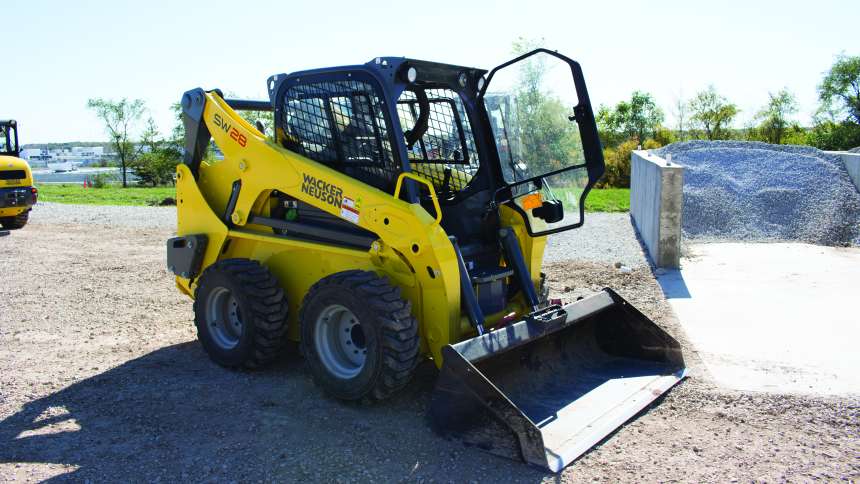
The SW28 Fertilizer Edition model from Wacker Neuson features eight counterweights.
Many observers to the agricultural marketplace might not know the name Wacker Neuson, Menomonee Falls, WI. While the company is well known for its equipment in the construction industry, it has only been offering its various lines of materials handling equipment to ag retailers in the U.S. for less than a decade now.
However, according to Brent Coffey, Product Manager – Loaders, the company makes up for this lack of awareness in terms of market reach by being very sensitive to the needs of the customers it caters to. “Our brand may not be as recognizable as many of the other companies out there for materials handling equipment, but being smaller has allowed us to have a laser-like focus on the needs of our customers and the whole industry,” says Coffey. “If I had to sum up our approach to the agricultural market in a single phrase, I would say we are very, very nimble.”
In many ways, he adds, this nimbleness dates back to the early days of the company’s first wheel loaders introduced back in the mid-1920s. For many decades, the legacy companies of Wacker Neuson focused on building up their market shares in their home markets before moving into new territories. In fact, the company didn’t first start offering its materials handling equipment in the U.S. until 2008, when many ag retailers were rapidly expanding upon their capabilities in the areas of storing and moving dry fertilizer for their grower-customers.
As the company and its product offerings in the U.S. grew, says Coffey, Wacker Neuson took note of the rapid expansion in fertilizer demand in the U.S. and decided the time was right to enter the country. This included products in the skid steer, telehandler, compact wheel loader, excavator, and compact dumper segments. “Wacker Neuson has a pretty diversified business line,” he says. “But a lot of our loaders have always been designed with agricultural needs in mind first and foremost, so coming into the U.S. market really wasn’t that difficult.”
Designed For Fertilizer
As evidence of this focus on agriculture, Coffey points to the Wacker Neuson SW28 Fertilizer Edition model. Besides being equipped with heavy-duty tires and a cab-forward design to improve operator visibility, the SW28 Fertilizer Edition features eight counterweights, increasing the lift capacity by adding 380 pounds to the rear of the machine. Applying a Nyalic anti-corrosion coating to the unit is also an option.
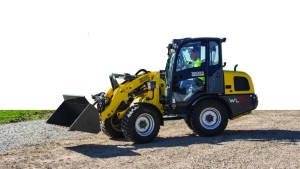
After customer input, the WL34 from Wacker Neuson was designed to prevent spills.
Another example is how Wacker Neuson designed its WL34 Articulated Wheel Loader for the U.S. materials handling market. “When this model was being launched, we asked customers what Wacker Neuson could do to make it better suited to handle fertilizer for ag retailers,” says Coffey. “Folks came back to us and asked if there was some way to reduce the amount of product spillage loaders tend to struggle with.”
To accomplish this, the company designed the WL34 with an exclusive kinematic system. “This uses a special linkage that is designed to continually roll the bucket back during lifting,” says Coffey. “This helps keep the bucket in a position which minimizes spilling of the fertilizer while being moved.” As an added option, the WL34 can also receive a Nyalic anti-corrosion coating as well, he says.
Now moving into its ninth year in the U.S. marketplace, Wacker Neuson will continue to build upon its past experiences while the company looks to tap into future trends. In particular, says Coffey, the consolidation/merger trend among ag retailers shows no signs of slowing down in 2016.
“We are seeing lots of larger fertilizer handling companies buying up smaller fertilizer houses,” he says. “This usually changes the footprint of the smaller companies involved and they start to look at using larger and more technologically-advanced equipment in their operations. That’s where Wacker Neuson can come into the picture. We can help them adapt our machines to their needs, so then both of us can grow going forward.”
Regarding other agricultural market trends for 2016 and beyond, Coffey doesn’t foresee any real alteration to how Wacker Neuson has, or will continue to, conduct its business philosophy. “As I said earlier, we have been a very, very nimble company in the U.S. market,” he says. “And we will continue to listen to the needs of our customers in determining what our products will be like in the future. That’s how we’ve largely been able to penetrate the marketplace, and I don’t see this changing anytime soon.”
Subscribe Today For
