Ag retailers sit on a wealth of customer data. Transaction records, CRM systems, agronomy histories. The problem is not access. It is interpretation.
That gap between data and insight is where most revenue leaks occur.
Steven Valencsin, chief executive officer and founder of GROWERS, and Steven Harrelson, chief operating officer for GROWERS, describe this gap in practical terms and quantify its impact. Their conclusion is straightforward. The signals that drive growth or signal risk already exist inside your business. Most retailers simply are not seeing them.
The Hidden Gap in Customer Intelligence
Start with wallet share.
Across 125,000 farmers and 40 retailers, GROWERS found that the average retailer captures just 28 cents of every dollar a farmer spends on inputs and services.
That leaves 72 cents going elsewhere, often with no visibility into where or why.

“The reason that’s a shock is most organizations assume they have a very loyal customer base,” Valencsin says. “But when you actually peel back the layers, you start to see a pretty alarming trend that we actually have much smaller wallet share than we think.”
This is not a small-account problem. It is concentrated in the accounts that matter most.
Top 10 percent customers generate about 70 percent of revenue, yet even those accounts give a retailer only about 60 percent of their total spend. That leaves significant revenue exposed inside relationships that look stable on the surface.

The core issue is not a lack of data. It is fragmentation.
“You’re data rich and intelligence poor,” Harrelson emphasizes. “We’ve got all these different segments of data. But we don’t have a sufficient way to aggregate that information and produce insights that are actionable.”
Why Dashboards Fall Short
Most retailers rely on dashboards to track performance. Those tools are useful but limited. They show what already happened. They do not show what to do next. That limitation becomes critical when customers start to drift.
Customer loss rarely happens in a single season. It unfolds gradually. A category drops off. Purchase frequency declines. Spend shifts to another supplier. By the time total revenue declines, the account is already fragmented across competitors.
Valencsin describes this as the “slow fade” problem.“By the time this revenue drop happens, that customer is already gone before we realize it,” he notes.
Compounding the issue, price fluctuations can mask the trend. Strong fertilizer pricing, for example, can hide declining seed or crop protection volume inside topline revenue.
Where the Real Opportunity Sits
Growth is not primarily in new customer acquisition. It is inside existing relationships.
The data shows mid-tier accounts hold the largest untapped potential. Customers spending $25,000 to $100,000 annually often leave six figures on the table in uncaptured spend.
“You don’t need to go find all new customers to grow,” Valencsin explains. “There’s enormous, untapped potential in your existing base. The trick is knowing where the gap is and how to approach it.”
For manufacturers, a parallel issue exists.
Many farmers are loyal to a single product but never expand into the broader portfolio. In one example, 87 percent of growers buying a manufacturer’s top product purchased nothing else.
The value gap is large. Single-product buyers average about $1,751 annually, while multi-product buyers exceed $12,000.
“The relationship is real. The pathway from one product to the next just doesn’t exist,” notes Valencsin.
The Signals You Are Missing
Customer churn is not random. It follows a pattern.
GROWERS identified five consistent behavioral signals:
- Purchase frequency drops
- Product mix narrows
- Seasonal buying patterns shift
- Repeat purchases disappear
- Late-season behavior changes
“These signals show up months before the revenue impact,” Harrelson says.
The challenge is timing. These signals are hardest to detect during peak seasons, when teams are busiest. Without continuous analysis, they go unnoticed.
The result is preventable loss.
Why AI Changes the Equation
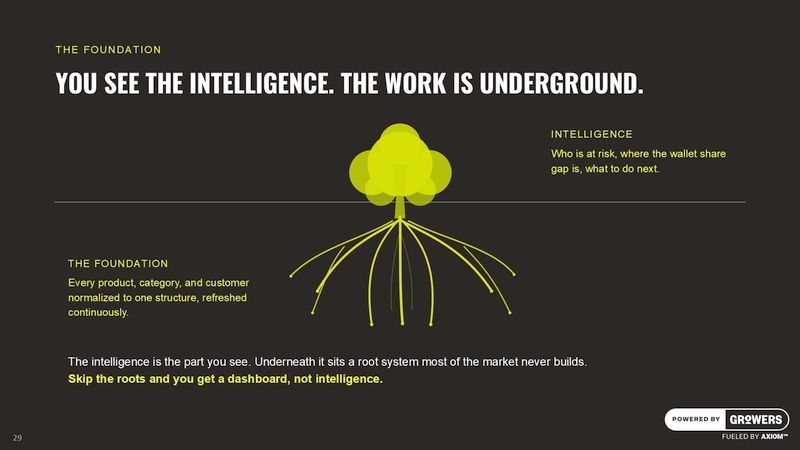
AI is not the differentiator on its own. The structure of the data underneath it determines whether it produces useful insight.
“AI is only as good as the data behind it,” Valencsin says.
Generic tools applied to raw data produce surface-level answers. To generate real intelligence, data must be standardized across systems, products, and customer records. That is a complex, often overlooked step.
Once that foundation is in place, the returns are measurable.
GROWERS reports that its models can flag 60 percent to 80 percent of at-risk revenue roughly 90 days in advance, with about 90 percent precision.
That lead time is the window to act.
Rethinking Loyalty as a Data Engine
One of the more practical takeaways is how loyalty programs fit into this model.
Most retailers view loyalty strictly as a retention tool. GROWERS frames it differently.
“Loyalty programs aren’t just retention tools. They’re data generation engines,” Valencsin says.
Each transaction within a program creates structured, standardized data across categories and locations. That continuous data stream feeds the intelligence layer.
It also changes farmer behavior.
Without incentives, growers tend to spread spend across multiple suppliers. Loyalty programs introduce a reason to consolidate purchasing, which increases visibility and deepens relationships.
What To Do Next
The takeaway is not to invest in more data systems. It is to extract more value from the data already in place.
Retailers should be able to answer a few specific questions:
- Which top accounts are most likely to fragment their spend this season
- Which customers are active in one category but absent in others
- Which accounts look healthy on revenue but are shrinking underneath
“If those questions are hard to answer, you’re flying on the topline alone,” Harrelson warns.
The data to answer them already exists in most businesses.
The difference is whether it’s being analyzed in time to act.

If you missed the live broadcast of this webinar, “What Your Customers Aren’t Telling You: How AI Is Unlocking Customer Intelligence for Retailers and Manufacturers” you can view the archived version online here or visit CropLife.com/webinars and check it out today.