
Why Water Conditioners Work for Aggressive Weed Control

THE POWER OF A WATER CONDITIONER: Without a water conditioner, growers’ weed control investments can be lost to hard water antagonism. Adding the right water conditioner to the tank could boost herbicide uptake by 2.1x.1
After planting this spring, the next step is focusing on how to protect growers’ investments and ensure maximum yield potential. If you’re working with customers to plan for well-rounded weed control, you’re already off to a solid start.
Unfortunately, when herbicides are sprayed, not all of the active ingredients make it into the target weeds’ leaves. Product antagonism, poor application practices, spray drift, unfavorable weather conditions and volatilization can all contribute to herbicide loss, says Mark Glady, an agronomist with WinField® United.
Don’t waste valuable weed control dollars on applications that aren’t working to increase the bottom line. Instead, consider recommending an effective water conditioner to improve herbicide performance.
The Science Behind Water Conditioners
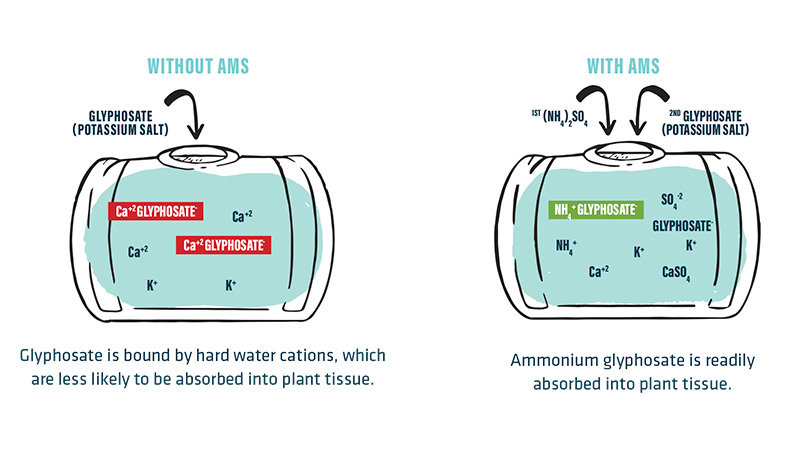
In a spray solution, weak acid herbicides can easily dissociate into mono-, di- or tri-valent anions with a negative charge. Those negatively charged herbicide molecules are attracted to positively charged mineral salts in the spray solution, including calcium, magnesium, sodium, potassium and iron. Plants do not easily absorb the bound salt-herbicide complex, so herbicide efficacy is reduced if the spray water isn’t conditioned.
So what are water conditioners? Glady explains that water conditioners are a type of adjuvant specifically formulated to prevent hard water mineral antagonism of weak-acid herbicides in a spray tank mix, resulting in enhanced herbicide performance. “Cations in the soil or on a leaf also can bind to herbicide particles, so water conditioners help block those interactions to improve herbicide uptake,” he adds.
How to Choose an Effective Water Conditioner
Chemical input suppliers’ product lists often offer many different water conditioning options. But not all water conditioners are effective with every spray application warns Glady: “There are many water conditioners on the market. Not all products offer the same benefits and performance, so make sure to do research before choosing a product.”
He explains there are two general types of water conditioners: AMS-based and acidifying. Glady breaks down the two types with us, including the benefits, when to use them and what products he recommends.
- AMS-Based Water Conditioners
Benefits of an AMS-Based Product
“AMS water conditioners provide two critical benefits for effective weed control,” Glady says. “The sulfate conditions hard water to bind antagonistic cations, while the ammonium improves plant herbicide uptake,” he explains.
When to Use
“AMS water conditioners are recommended for weak-acid herbicide applications, including glyphosate, glufosinate, Enlist®, 2,4-D amine, clethodim or PPO inhibitors,” Glady notes.
Recommended Products
Class Act® NG® adjuvant has been a leader in AMS-based water conditioners for more than 20 years. Glady says, “The formulation combines AMS with a nonionic surfactant, a humectant and antifoaming agent in a liquid premix. The nonionic surfactant improves the spreading and sticking characteristics of the herbicide to improve plant absorption and metabolism, resulting in faster and more effective weed control,” he clarifies.
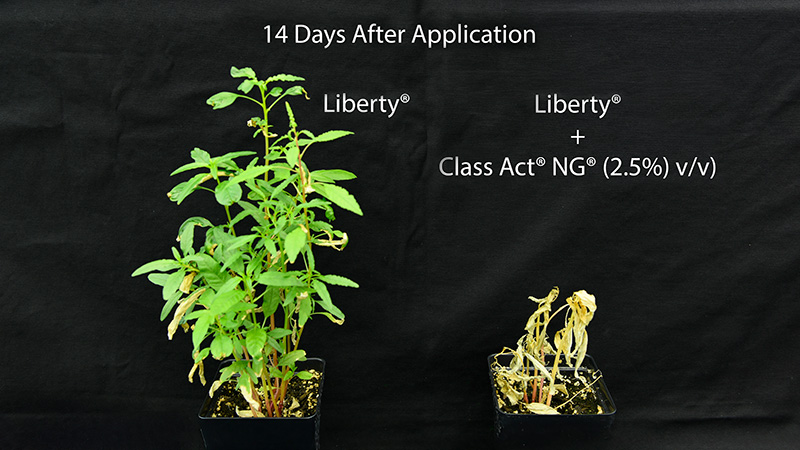
Class Act NG adjuvant increases active ingredient uptake by 1.5x when used with Status®, 1.4x with Enlist One®, 1.8x with Liberty® and 2.1x with glyphosate, compared to AMS for better, faster herbicide efficacy. 1,2
“Another benefit of Class Act NG adjuvant is the pre-dissolved liquid AMS alleviates sedimentation and nozzle plugging in the sprayer,” Glady adds. “It’s formulated with a humectant, WinField® United CornSorb® technology, to help improve herbicide uptake and movement in the plant.”
- Acidifying Water Conditioners
“Although some exceptions exist, many herbicides are most effective in slightly acidic mixtures,” Glady says. “If the spray solution is too alkaline or acidic for the herbicide being sprayed, it may break down faster and be less effective. So, acidifiers work by lowering the pH and neutralizing salts in the spray solution to improve the impact of herbicides,” he details.
Benefits of an Acidifying Water Conditioner
Besides AMS-based products, acidifying water conditioners can be an effective choice for water sources that do not face the same water hardness challenges. “For water sources that do not have high-water hardness levels, acidifying water conditioners are a viable alternative to AMS-based water conditioners and typically require lower use rates,” Glady mentions.
When to Use
“Acidifying water conditioners are most effective in soft water areas when weed control is timely and weeds are not hardened off,” he advises.
Recommended Products
“Most often, acidifiers are a component of multi-function adjuvants, like those in the WinField United OPTIFY® lineup,” Glady says.
For those searching for an effective acidifier, he recommends OPTIFY L27 adjuvant, a convenient, versatile blend of acidifying water conditioner, AMS and nonionic surfactant designed to optimize performance with a low-use rate. “OPTIFY L27 adjuvant is designed to enhance the performance of tank mixtures containing glyphosate, for use on glyphosate-tolerant crops in soft water areas,” explains Glady.
Get Effective Weed Control on the First Pass
Herbicide supply constraints and rising input costs require a more thoughtful approach to weed management. That’s why Glady urges it’s critical to help growers implement best application practices, including recommending the right water conditioner.
“In some cases, growers may not have an option for a second herbicide application, or it may not be economical,” he says. Adding an effective water conditioner to the tank mix can help maximize success on the first pass.”
1Colorado State University. Phil Westra research conducted in 2004.
22024 WinField United Innovation Center Controlled Environments study comparing herbicide leaf uptake comparing using Class Act NG adjuvant v. dry AMS.