Building Better Biology at the Seed with BioBoost
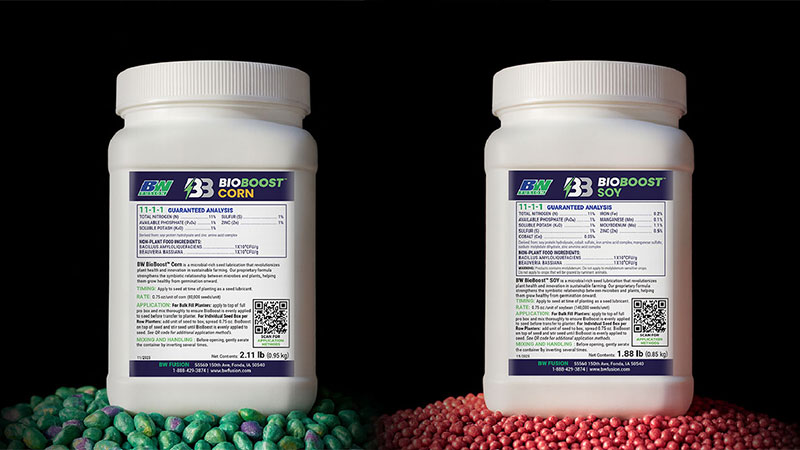
Biologicals promise a lot, yet many fail at the first and most important step, creating a real connection between microbes and the seed. Jason Schley, president of agronomy at BW Fusion, says that gap drove the development of BioBoost. “A lot of people create seed treatments, but many don’t work the way they’re intended because they can’t actually create that relationship with the plant,” he explains. The team set out to solve that problem directly by engineering a product that helps plants communicate with microbes from day one.
Schley describes early microbial association as the point where everything downstream becomes easier for the plant. A seed that quickly forms those connections starts stronger, draws in nutrients more efficiently, and handles stress at a lower energy cost. “If we get that to happen, everything from that day forward is easier for the plant,” he says.
A Stacked Approach to a Crowded Category
Planter box treatments tend to fall into narrow categories. Lubrication. Biology. Nutrients. BioBoost takes a broader approach. Schley calls it “a combination that we feel is going to find a limitation,” meaning the product is built to address a wide range of early‑season barriers.
Its formulation includes synthetic micronutrients, beneficial bacteria, endophytic fungi, carbon, and amino acids. Each plays a different role. The carbon fuels microbial activity. The amino acids support the plant while also feeding the microbes. The microbial package establishes the biological relationship. The micronutrients cover early nutritional gaps that often limit young plants.
This stacked design is intentional. Schley says its diversity allows BioBoost to perform in a wide range of soils. That includes conditions that swing too wet or too dry, or fields that vary in nutrient load. “We gave it several modes of action so it could thrive in any environment,” he says. Retailers looking for predictability across inconsistent conditions will recognize the value in that approach.
Consistency Matters More Than Novelty
Retailers have good reason to be skeptical. Biologicals come and go quickly, often with big claims and limited field proof. Schley knows consistency is the barrier companies must clear. BW Fusion focused on that from the start by designing BioBoost to deliver multiple layers of support rather than relying on a single mechanism. The result, he says, is steady performance across environments.
In BW Fusion’s trials, BioBoost delivered 2025 yield gains close to 7.5 bushels per acre on corn and around 4 bushels on soybeans. Those numbers widen the target audience. “It works for any grower,” Schley says. Still, he sees strong uptake among growers who think about plant energy management and how early support can improve defense and nutrition throughout the season.
Where Planter Box Biologicals are Heading
Schley expects planter box biologicals to grow because the application point is simple and effective. It puts biology right where it needs to be, at the seed and in the soil at the same time. Foliar and broadcast applications have their place, but they miss the crucial early association. “We feel we have a double impact here. Not only do we affect the soil, but we also affect the plant,” he says.
He also cautions against stacking products without discipline. BW Fusion spent years refining BioBoost. Overloaded mixes can work against themselves. “You could push too hard and work against a lot of the benefits and actually go backwards,” Schley warns.
A Broader Goal: Better Soil, Not Just Better Crops
Schley has one more point he believes will matter in the future. Every BW Fusion product is built to improve both the current crop and the soil it relies on. Long‑term soil carbon loss has pushed BW Fusion to design products that rebuild rather than deplete. “Every product we create has a net positive not only to the cash crop but also to the soil,” he says.
BioBoost reflects that design philosophy. It supports early plant development, strengthens microbial relationships, and adds biological activity that supports soil health over time. For retailers looking for reliability in a crowded category, it offers a grounded, agronomy‑first approach to biological performance.