How Mother Nature Shapes 2026 Fungicide Strategies

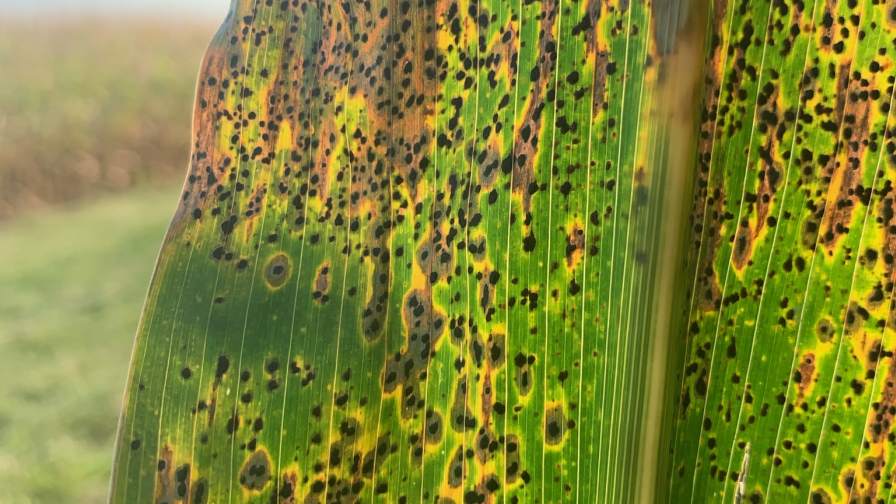
Over the past eight years, tar spot has spread widely across corn acres. Photo: Syngenta
The past few years, extreme weather events have become much more commonplace across the entire globe. In the U.S., it seems as if incidents of drought and deluges have plagued certain regions of the country every growing season since the 2020s began.
“No one year is ever the same,” says Kim Tutor, Technical Marketing Manager, Corn and Wheat Fungicides at BASF. “Not only [is the climate] changing for us but for our crops as well. We have to combat the ever-changing weather patterns such as heat, drought, wind, rain, and hail.”
Unfortunately, Tutor adds, these weather extremes bring an unwanted side effect to the world of agriculture — increased crop disease pressure.
“It can be things such as tar spot in corn or frogeye leaf spot in soybeans,” she says. “All of these factors combined have the ability to limit yield and profitability for growers.”
It’s for all these reasons, says Gail Stratman, Regional Technical Services Manager at FMC U.S., that the use of fungicides have become increasingly important for row crop growers in recent years.
“Fungicide programs have long been used in high-value vegetable crops to protect our fresh market food supply,” says Stratman. “It’s only in the last 15 years that we’ve learned how they can also provide that same level of yield protection in large-acre row crops as well. In addition to disease control, we’ve learned that [fungicides] also function to help plants reduce the impact of stress, improving overall plant health and reducing the risk of yield loss.”
Still, according to Albre Brown, Technical Marketing Manager, Row Crop Fungicides at BASF, fungicide use in row crops isn’t that widespread. In fact, based upon the company’s own estimates, only 45% of the more than 180 million acres of corn and soybeans planted in the U.S. during 2024 were treated with fungicides.
“This means that over 100 million acres were not treated because growers didn’t see any evidence of disease,” says Brown. “But by the time diseases show on the outside of a leaf, it’s usually too late to save the yield. When applying fungicides, you want to be on the preventative side of disease control, not just the curative side.”
The 2025 Review, 2026 Outlook
In 2025, there were three primary diseases that caused the most issues for row crop growers, says Darrin Holder, Market Development Agronomist Lead at WinField United.
“Tar spot and Southern rust in the last couple of years have been giving us trouble in corn and soybeans,” says Holder. “And we continue to have issues with frogeye leafspot in certain geographies.”
Christy Hetfeld, Portfolio Marketing Manager, Fungicides at UPL, agrees with this assessment of most troublesome diseases for 2025, with some issues going back much further than just last year.
“In the past eight years, we’ve seen a huge spread of tar spot across corn acres,” says Hetfeld. “However, this past season, Southern rust was a surprisingly large problem, as favorable warm temperatures and wind brought it farther north than usual. Gray leafspot and Northern corn leaf blight continue to be consistent problems in corn, and frogeye leaf spot and white mold are the biggest issues in soybeans.”
According to Ron Geis, Market Development Specialist at Corteva Agriscience, ag retailers and their grower-customers can probably expect these same diseases to once again appear in large infestations in row crop fields during the 2026 growing season.
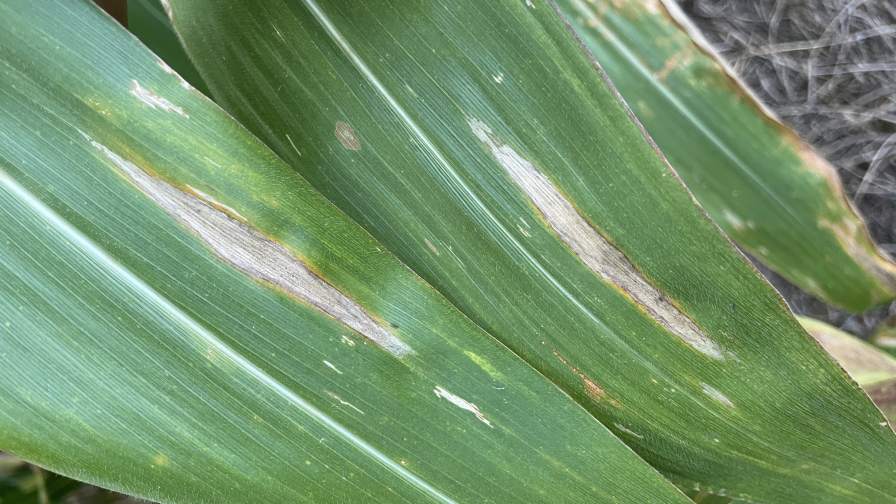
Northern corn leaf blight. Photo: Edward Sikora, Auburn University, Bugwood.org
“In corn, the big four diseases to keep on the radar are tar spot, Northern corn leaf blight, gray leafspot, and rust because these diseases have historically caused farmers the most yield losses,” says Geis. “Corn farmers in the Northern Plains should be ready to focus on historically consistent diseases like tar spot, Northern corn leaf blight, and possibly gray leafspot if weather turns warm. After moving into Iowa and the Northern Plains in 1999, Southern rust appeared across many acres in 2025.”
Based upon his reading of the disease situation from 2025, FMC’s Stratman believes row crop growers should also keep an eye out for infestations of tar spot and Southern rust during 2026.
“Tar spot continues to spread across a large area of the Corn Belt,” he says. “The tar spot pathogen and the inoculum is in many fields, stretching from Kansas to the Dakotas to other points in the East. If we get more favorable conditions for tar spot, I can easily see that disease becoming a greater annual threat.
Stratman continues, “We had a heavy infestation of Southern rust the last couple of years in the Western Corn Belt, but that disease doesn’t overwinter in the Corn Belt. We had very warm and extended humidity during the summer of 2025, which really drove the high levels of infection we saw. We’ll have to watch the weather conditions in the South for the winter. Warm and wet conditions in the coastal areas of the U.S. and Mexico could allow for Southern rust to be an issue there and bear watching for a potential infection in the Midwest when summer arrives.”
Tyler Harp, Technical Product Lead for Fungicides at Syngenta, foresees a similar disease scenario playing out in 2026 as Stratman.
“Diseases such as tar spot and Northern corn leaf blight overwinter in the field, so the inoculum is already there,” says Harp. “Once a crop is planted in that location, all you’ll need are those environmental conditions for a disease epidemic to begin. You have the crop. You have the host. You’re just missing the environmental conditions and a little bit of time, but that’s likely to happen in parts of the Corn Belt and likely to not happen in other parts at any given time during the growing season.
“Southern rust is one of the diseases that does not overwinter in the field,” he continues. “It must come in new every year from the South. That’s going to depend on even more complex environmental conditions, which we did see in 2025 with moisture continuing to come up through the Gulf and bringing spores into far north parts of the Corn Belt, even as far north as Iowa and Wisconsin.”
UPL’s Hetfeld also thinks tar spot bears watching this year.
“The acres of corn that are treated for tar spot have grown at a rate of more than 150% year-over-year for each of the past six years,” she says. “It wasn’t as much of a problem as expected in the 2025 growing season, as the temperature in much of the corn acres during the peak tar spot season was too warm for tar spot to develop. However, we know that the spores are still present in the fields, and growers should plan to apply a preventative fungicide in 2026.”
More Fungicide Applications Coming
Because of the increase in disease pressures in the past few years, Hetfeld says that UPL is expecting an increased volume and consistency of fungicide applications in corn and soybean fields, particularly among those growers who didn’t apply fungicide in the 2025 season and experienced yield loss because of late season heavy disease pressure.
“Similarly, we saw a jump in the number of corn growers who applied a fungicide twice or even three times in 2025, and we expect that trend to continue into 2026,” she says. “Growers should look for a broad-spectrum fungicide that offers control — not just suppression — of these key diseases and more. The best fungicide products for complete disease control and resistance management will have two or three active ingredients combined into one application.”
To aid this effort, Hetfeld adds, UPL is expecting to receive EPA registration of a new dual mode-of-action fungicide, Telaron Alpha, later this year. “Telaron Alpha will be a broad-spectrum option for growers who are considering applying a fungicide for the first time, or as a secondary spray in the season,” she says.
In addition, Trey Cutts, Vice President of Commercial Agriculture Science at Tidal Grow AgriScience, says ag retailers and their grower-customers should consider upgrading some of their approaches to disease control.
“The outlook for crop diseases in 2026 remains elevated and increasingly complex,” says Cutts. “We are seeing more frequent weather volatility — extended leaf wetness, temperature swings, and episodic stress — that favors disease development across both row and specialty crops. At the same time, tighter rotations, higher yield goals, and genetic compression in some cropping systems continue to increase disease pressure. As a result, disease management in 2026 will be less about reacting to outbreaks and more about building resilience and consistency into fungicide programs.”
This is where a product such as Tidal Grow’s Spectra could come into play, he says. “A bio-based fungicide, Spectra is designed to support conventional fungicide programs by improving plant response, stress tolerance, and overall program efficiency,” says Cutts. “These tools become particularly valuable when fungicide windows are tight, pressure is variable, or environmental conditions limit ideal application timing.”
Looking forward, Cutts doesn’t believe the need for fungicides will diminish for row crop growers and their ag retail suppliers anytime soon, given how the past few years have played out when it comes to increased disease pressure.
“The fungicides market will remain essential to agriculture, but it will continue to evolve beyond chemistry alone,” he predicts. “Future programs will rely more heavily on integrated solutions that combine genetics, chemistry, biologicals, and digital decision tools. Disease pressure is not diminishing, and yield expectations continue to rise, making effective disease control non-negotiable. The opportunity lies in smarter, more resilient systems — not simply higher input intensity.”
Subscribe Today For
