CropLife 100 Report: Seed Sales Slip in 2025, But Long-Term Stability Holds

In an overall flat marketplace, a sales decline has to be considered a loss. For the seed category, 2025 was not the best of years, according to the numbers.
Based upon the data collected from the nation’s top ag retailers in the annual CropLife 100 survey, seed sales for 2025 dropped back slightly from their 2024 numbers – down $100 million, from $5.8 billion in 2024 to $5.7 billion. If there’s some good news to be had from this revenue drop, it’s that it wasn’t severe enough for the seed category to lose any market share compared with other crop inputs/services tracked in the CropLife 100 report. This held steady at 13%.
According to market watchers, the seed category has not experienced many of the supply chain disruptions and extreme market price swings that have plagued other crop input categories such as crop protection products and fertilizer these past few growing seasons. It also probably hasn’t hurt the category that some of the geopolitical forces affecting global supply/demand don’t seem to apply to seed.
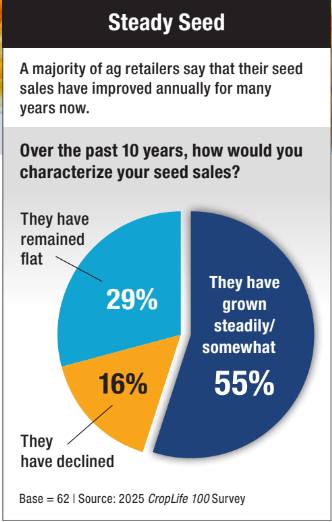 Furthermore, overall, ag retailers say their seed revenues over the past decade have remained fairly consistent. According to data from the 2025 CropLife 100 survey, 29% of the nation’s top ag retailers that sell seed say their sales have grown “somewhat” since 2015. Another 26% indicated that the seed category revenues for their operations have grown “steadily” during this time span. Twenty-nine percent indicated that their overall seed sales have been flat in the last decade or so. The remaining 16% of respondents said that their seed category sales had dropped during this time.
What Motivates Seed Purchases?
In terms of what motivates seed purchases from CropLife 100 ag retailers, the 2025 survey results indicate that there is one factor that drives the majority of sales. According to the 2025 CropLife 100 survey, 58% of grower-customers make their seed purchases from the nation’s top ag retailers based upon the type of seed variety they need/want for their crop fields.
After variety type, a distant second reason for grower-customers to buy the seeds they do ties back to location conditions – specifically soil type. This was cited by 21% of CropLife 100 ag retailers for why their seed customers buy the seeds they do.
As for the remaining 21% of respondents, they indicated that their seed customers buy products based upon such factors as weather (3%) and “it’s the seed type they have always bought, so our company keeps that one in stock” (18%).
Subscribe Today For
