Corn Under Pressure: How NCGA Is Keeping U.S. Agriculture Competitive and Sustainable

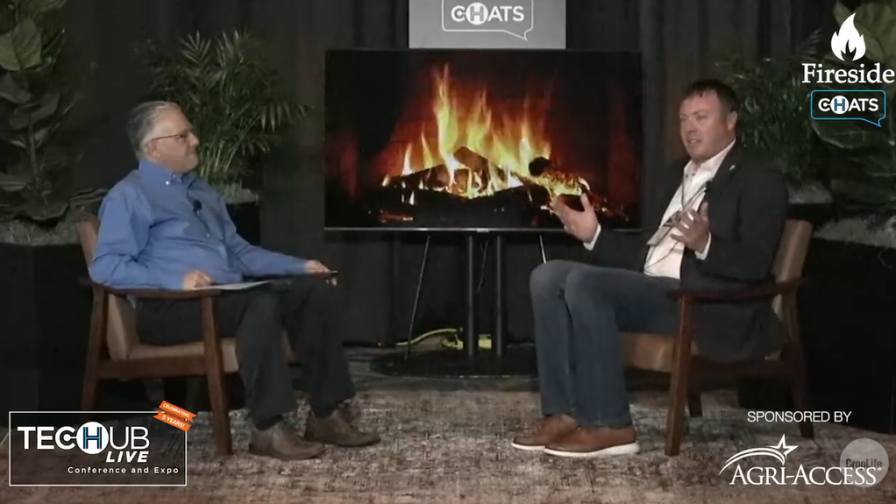
Harley Janssen (right), Director of Outputs and Measurements at the National Corn Growers Association (NCGA), joined CropLife Editor Eric Sfiligoj for a Fireside Chat at the 2025 Tech Hub LIVE in Des Moines, IA.
At the 2025 Tech Hub LIVE in Des Moines, IA, Harley Janssen, Director of Outputs and Measurements at the National Corn Growers Association (NCGA), joined CropLife for a Fireside Chat to discuss how markets and mandates are influencing the future of farming. Representing over 36,000 dues-paying members and 300,000 corn growers nationwide, Janssen shared how NCGA is navigating a rapidly evolving agricultural landscape shaped by shifting consumer demands, regulatory pressures, and international trade.
Balancing Market Demand with Farmer Viability
“There are really two main areas we focus on,” said Janssen. “First, we work to generate market demand — opening access to markets and improving farmer profitability. On the other side, we deal with the increasing regulatory challenges and work to protect farmers’ freedom to operate.”
The association sees growing opportunity in what Janssen called “sustainable marketplaces,” as more downstream buyers seek to meet ESG and carbon reduction goals. He emphasized that many growers already practice sustainability in meaningful ways, though these contributions often go unrecognized.
“A big part of what we do is tell that story — connecting the numbers we represent in the grower community to the demands of downstream markets and the open access they require,” Janssen explained.
The Fight to Keep Tools in the Toolbox
Janssen highlighted a critical and ongoing challenge: the increasing difficulty in retaining access to trusted crop protection tools, particularly herbicides like glyphosate and atrazine, which have come under regulatory and political fire in recent years.
“What we don’t say out loud enough is that we wouldn’t have made the conservation gains we have without access to key technologies,” he said. “We spend a lot of time walking people through the 30-, 40-, even 50-year history of these chemistries, explaining how important they are — not just for productivity, but for achieving the very sustainability goals that policymakers are pushing for.”
To support its advocacy, NCGA funds and disseminates independent, peer-reviewed research that legislators and stakeholders can reference when evaluating regulatory policy.
Putting Faces to the Farm
Beyond data and legislation, Janssen said NCGA is working hard to humanize the story of American agriculture.
“We’re working to show that behind the numbers are real people — roughly 300,000 family farms doing the hard work every day to meet demand,” he said. “We’re farming fewer acres today than we did in 1925, but with nearly 900% to 1,000% more production. That’s an incredible land-use efficiency story that sets us apart globally, especially compared to South America.”
It’s these kinds of facts, he argued, that need to be more widely shared, not just within the industry but with consumers, regulators, and global trade partners.
Countering Misinformation, Championing Science
In response to recent reports critical of industrial agriculture — such as those framing U.S. food production as harmful to health or the environment — NCGA is doubling down on fact-based advocacy.
“There are misunderstandings about how we farm, the technologies we use, and the safety of the tools in our toolbox,” Janssen noted. “All of these tools have gone through rigorous regulatory processes via the USDA and EPA. We’re simply asking policymakers to recognize the science that’s already been done and see farmers not as part of the problem — but as part of the solution.”
Trade Wins in Mexico and Europe
Despite ongoing challenges, NCGA has seen recent victories in global trade. One major breakthrough came in Mexico, where the organization played a key role in a legal battle related to the U.S.-Mexico-Canada Agreement (USMCA).
“We were able to win a legal battle and open that market back up, which is extremely important for us,” said Janssen. “Mexico is a major trade partner, and in the grain space, we rely on trade. It took time, but ultimately, the facts prevailed—and that was a major victory for farmers.”
He also pointed to a recent shift in Europe, where regulators have approved biotech corn for animal feed — a long-awaited move by one of the world’s most resistant markets.
“It might seem like a baby step, but it’s a very significant one,” Janssen said. “Animal feed is the largest consumer of corn worldwide, so opening that door is important. We believe science and facts will continue to open more markets.”
Looking Ahead
As the agricultural sector continues to evolve, Janssen made it clear that NCGA’s focus remains firmly on ensuring farmers have both the freedom and the tools to meet demand sustainably.
“Our members are ready to meet the moment,” he said. “They just need the support, the science, and the market access to do it.”
Subscribe Today For
