N Stabilizers: A Model of Consistency in Nitrogen Applications
 March 12, 2025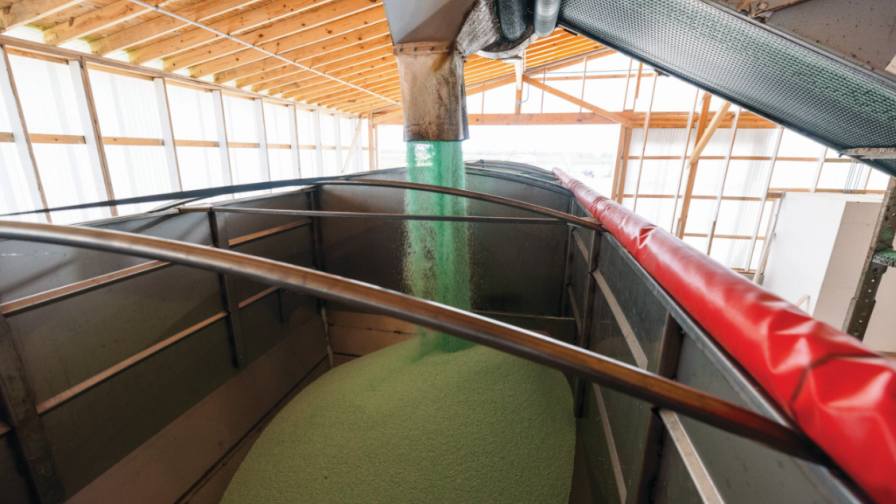
With two active ingredients working in tandem, ANVOL extends the protection of your nitrogen investment so more of the applied nitrogen is available for crop uptake and provides a longer duration of protection from nitrogen loss through volatilization. Photo: KAS
For nitrogen (N) stabilizers, the 2024 growing season was pretty solid, sales-wise. That’s the evaluation from several N stabilizer providers that recently spoke with CropLife® magazine on the category’s performance.
“Fertilizer prices and other cost pressures incentivized farmers to maximize the efficiency of their nitrogen applications,” says Tim Laatsch, Director of Agronomy North America, Koch Agronomic Services (KAS) the makers of ANVOL and CENTURO N stabilizers, of growers in 2024. “[This increased] interest in using stabilizers to maximize their yields and profitability.”
Alan Sparkman, Senior Vice President of Sales, North America, Verdesian Life Sciences, makers of N-Charge and OUTLAST, agrees with this assessment, adding that N stabilizer usage tends to follow corn acreage patterns.
“2024 proved to be a good year for the nitrogen stabilizer business,” says Sparkman. “The overall nitrogen business ebbs and flows with total corn acres planted and nitrogen stabilizers follow those trends. Even though corn acres for 2024 were slightly down, according to USDA numbers, it ranked as the eighth highest planted acreage in the U.S. since 1944. Growers recognize that nutrient efficiency benefits not only the environment but also their bottom line, so they continue to rely on these tools to best manage their fertilizer applications and input dollars.”
The Outlook for 2025
With 2024 now in the ag industry’s rearview mirror, what are the prospects for N stabilizers for the upcoming 2025 growing season? According to Sparkman, it’s a bit difficult to predict at the moment.
“It’s no secret that commodity prices have weakened over past years, and while growers can’t control crop prices, they can control two factors in the equation: Crop input costs and crop yield,” he says. “By investing in a N stabilizer, growers lose less of the fertilizer dollars they are spending. It’s a bit of a cliché, but protecting against nitrogen loss protects the farmer bottom line. Over the years, we have also seen ag retailers gain a deeper understanding around nitrogen management and how N stabilizers play a role in that process. It’s important to remember that compared to other ag inputs, mainstream nitrogen stabilizers have only been around for around 20 years.”
Steve Carlsen, Director of Proprietary Products at CHS, Inc., makers of N-Edge, also cites commodity prices for driving the expected N stabilizer demand in 2025. “The commodity prices can drive the use of products – both in terms of the grain produced and the inputs needed to produce them,” says Carlsen. “As prices for inputs increase, growers are more interested in protecting their investment. With lower commodity prices, you need to protect the bushel and do whatever you can to increase your yield potential.”
In addition, he also thinks one of the ag industry’s continuing priorities will aid in N stabilizer usage, this year and beyond.
“Sustainability is another trend farmers are watching and there are regulations on a regional, state or national level that could drive greater use of these products to help minimize impact on rivers and water ways,” says Carlsen. “We’re also seeing government programs that offer incentives for farmers to use stabilizers. At the same time, farmers are really tied to the land and want to do the right thing by using products that help them be agronomic, economic, and sustainable.”
Of course, according to Ron Calhoun, Senior Portfolio Marketing Manager for Plant Nutrition, Loveland Products, Inc. (part of Nutrien), the basics still come into play when growers are considering whether or not to use N stabilizers on their crop fields.
“Are you trying to protect aboveground losses, belowground losses, or both?” says Calhoun. “It’s important for growers to identify the main areas of risk to help them determine what stabilizer products will be most effective for their situation. When is the bulk of your material applied? What environmental losses are most likely during that time? How does your timing relate to the stage of crop growth and demand? Is your ground irrigated? Do you anticipate an incorporating rain event? Or is it dry land with no precipitation forecast? You may have different risks you’re trying to limit early season versus late season. With so many products available, it’s important for growers to discuss their concerns and objectives with their crop consultants to ensure the right solution is found.”
A Good or Bad Year Ahead?
Given all these factors, the read on what kind of year 2025 will ultimately be for the N stabilizers marketplace is a bit murky. According to KAS’ Laatsch, it could go either way.
“On the plus side, farmers are committed to continuous improvement and increasing productivity to meet growing demands,” he says. “There is growing awareness among farmers about the benefits of using stabilizers. They are seeing real results for themselves and hearing about them in trials and from neighbors, which will continue to support demand. On the other hand, we know that margins are going to be tight again this year. That means every decision will face extra scrutiny, and there may be hesitation to try something new.”
Chris Kluemke, Nitrogen Stabilizer Market Development Specialist for Corteva Agriscience, marketers of N-Serve and Instinct NXTGEN, also foresees some potential challenges ahead for N stabilizers this year.
“It’s impossible to speculate exactly what could happen in the future,” says Kluemke. “However, with the difficult farm economy, we may see some corn growers deciding not to use stabilizers. These growers may think they can afford to add more nitrogen later in the season if they experience loss rather than incur the cost of a stabilizer.
“We would caution against this line of thinking, particularly the idea of simply adding more nitrogen later in the season,” he continues. “It’s important to remember that applying additional nitrogen in crop doesn’t guarantee it will be there when the corn needs it. Nitrogen is always vulnerable to loss no matter when a grower applies it, or how much. Additionally, there is a misconception that a stabilizer isn’t necessary with spring or sidedress applications. We would advise growers to use a stabilizer with every application. If, for example, a heavy rainstorm follows application, unstabilized nitrogen will do little good for a corn crop — and, instead, put more nitrates into the environment while costing the grower money.”
Still, other market insiders expect N stabilizers to continue to perform well vs. other product categories, primarily because their underlying advantages will remain intact.
“Given current market dynamics, we believe the outlook for N stabilizers will continue to be strong,” says CHS’ Carlsen. “Given today’s lower commodity prices, growers still need to produce bushels and protect their inputs. Adding stabilizers into their crop nutrient mix will continue to help farmers get a better return-on-investment.”
Loveland Products’ Calhoun agrees. “We expect grower demand for N stabilizers to continue to grow in the foreseeable future,” he says. “The market expects the agricultural industry to be looking for ways to increase its sustainability. N stabilizers are an excellent tool for growers to increase their nutrient use efficiency and help build towards a more sustainable future.”
And according to Verdesian’s Sparkman, the growing biologicals sector could also spur demand for N stabilizers going forward. “The focus around biologicals and biostimulants in the marketplace continues to grow,” he says. “These products play a big role in nitrogen management, which adds another tool in the toolbox for ag retailers and growers.”
In this vein, Nutrien Ag Solutions earlier this year introduced a new product to the marketplace called N-FINITY. “N-FINITY is a first of its kind biological solution designed to supplement the soil’s ability to access nitrogen,” says Loveland Products’ Calhoun. “N-FININTY has three modes-of-action — direct fixation of atmospheric soil nitrogen through the application of nitrogen fixing isolates, recruitment of additional N-fixer to the rootzone, and liberation of stored soil organic nitrogen. N-FINITY can be mixed with at-plant in-furrow nutrition for easy incorporation into existing farm plans.”
Subscribe Today For
