Agriculture Associations Prove Their Worth Amidst Industry Challenges
 March 13, 2025
 Throughout all segments of the agriculture industry there are shared challenges that range from regulatory, to economic, labor, and more. While constant change is a given in agriculture, the current environment is particularly dynamic — if not downright unpredictable.
Recently, CropLife® visited several of the leading agriculture associations to discuss the top issues on the agenda for 2025.
While individual strategies and goals were unique, the messaging from association leadership was undeniably focused on one aspect: Collaboration.
Responding to EPA’s ESA Workplan
EPA obligations to comply with the Endangered Species Act (ESA) have a significant impact on growers, retailers, and suppliers of crop protection products.
Working together, the Council of Producers & Distributors of Agrotechnology (CPDA), Agricultural Retailers Association (ARA), The Fertilizer Institute (TFI), CropLife America (CLA), and National Association of State Departments of Agriculture (NASDA) are successfully shaping and guiding the EPA’s strategies pertaining to herbicides, rodenticides, insecticides, and fungicides.
This is no small feat. The EPA’s rollout of each strategy started in 2024 and will continue into 2026. Pesticide labels for new products and products subject to renewal will be scrutinized under the EPA’s updated obligations to comply with the ESA. Finally, growers will assume much of the burden, including cost, to mitigate pesticide drift and run-off from every field to avoid excessive buffer zones that could reduce acres in production.
The CPDA chalked up a noteworthy win with its efforts to include drift reduction adjuvants (DRAs) as a mitigation option. Although it was not included in the EPA’s draft Herbicide Strategy from 2022, DRAs were included in the release of the final Herbicide Strategy in August 2024.
During a presentation at the Beltwide Cotton Conferences in January, Dr. Stanley Culpepper of the University of Georgia acknowledged the stark differences between the draft and the final versions of the Herbicide Strategy, describing the final version as “workable” from an industry standpoint compared to the highly restrictive draft.
For its part, the ARA has led the charge to address the shortage of technical service providers (TSPs) in the industry and streamline TSP certification via the USDA’s Natural Resources Conservation Service (NRCS). Under the “Increased TSP Access Act,” TSPs — who are often paid using conservation program dollars — will be paid a fair market rate for their services.
Expanding the TSP ranks will provide much needed assistance to farmers and retailers as they navigate compliance requirements under the various EPA strategies.
As for enforcement of the EPA’s strategies, it’s yet to be determined on who [which agency] and how this will be accomplished. It’s likely that each state’s Department of Agriculture will ultimately be responsible for overseeing compliance.
According to Ted McKinney, CEO of NASDA, it’s critical for the industry associations to maintain open communication as details like enforcement and compliance become available. Whether it’s designing training programs for the industry or providing feedback to the EPA as it finalizes its strategies, the goal is to avoid overlap and duplication of efforts and speak with a unified voice.
In addition to the focus on EPA’s ESA workplan, industry associations are keeping a close eye on trade policy under the Trump Administration.
In early February, TFI urged the administration to exempt Canadian potash and other fertilizers from tariffs.
According to a TFI press release: “The U.S. relies on imports for over 95% of its potash fertilizer needs, with nearly 90% of that coming from Canada. Canada also supplies U.S. growers with more thn 8% of our nitrogen fertilizer needs, accounting for 25% of U.S. nitrogen fertilizer imports.”
CLA’s Alex Dunn Marks One-Year Anniversary
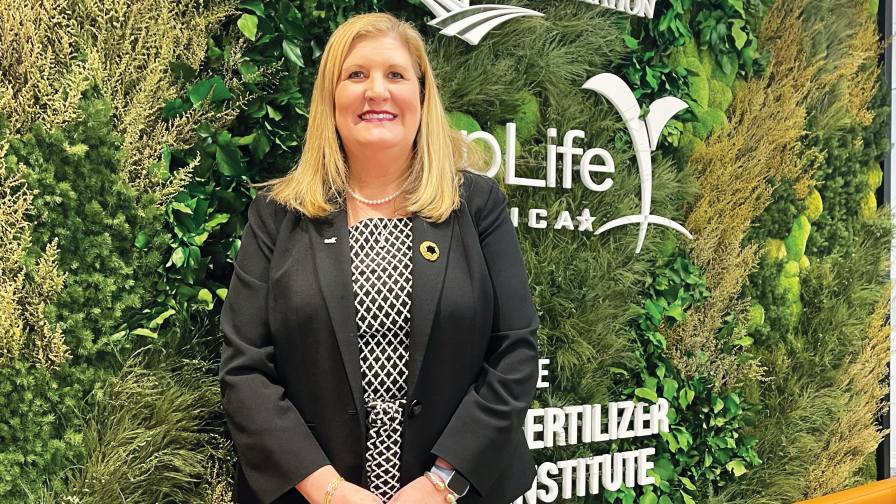
CropLife America’s (CLA) President and CEO Alex Dunn marked her one-year anniversary with the association this spring.
CropLife America’s (CLA) President and CEO Alex Dunn marked her one-year anniversary with the association this spring.
Dunn has made impressive progress on several fronts, including strengthening partnerships with the Council of Producers & Distributors of Agrotechnology, Agricultural Retailers Association, and The Fertilizer Institute, and engaging with growers to raise awareness about industry challenges and how CLA can help address them.
CLA has also enhanced its engagement with members through extensive, in-depth interviews to hear their perspectives on successes at CLA, as well as what could be improved.
In addition to sharing efforts with other associations on top issues like ESA and trade policy, Dunn noted that CLA is working with the Trump Administration to improve the pesticide registration process so American farmers have access to the best tools, thereby helping to keep rural economies strong and ensure farmers maintain a competitive edge in global markets.
Subscribe Today For
