Transporting Products Safely

Consider these safety tips when moving product at your ag retail operation.
-
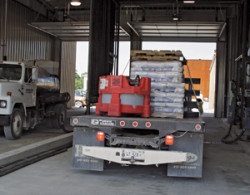
Bulk pesticides at Daylight Farm Supply are loaded and unloaded from trucks under roof and within the drive-through containment area, allowing loading and unloading in all types of weather. The drive-through area is large enough to allow semi tankers to unload and be completely inside of the containment area.© 2008 -
Transport trucks offload bulk chemicals in a full containment structure at UAP Distribution. Minibulk containers are also triple rinsed in this area to prevent cross contamination.© 2008 -
This building at Crop Production Services was built in 2001. It has sealed curbed walls for containment. We can fill mini bulks without leaving the building with the forklift. Products stay inside the containment area until shipment.© 2008 -
The Agro-Culture Liquid Fertilizers site in Williams, IA, is equipped with a railroad spill containment system. A liner was placed below the ballast of the track with perforated tiles that also run the length of the track. These drain into a cement tank vault and in event of a spill, any lost product would be contained there and can be recovered.© 2008 -
Many facilities utilize cement containment pads in the loading and unloading areas. In addition, drip pans prevent soil and groundwater contamination.© 2008 -
Nichols Ag has strict procedures about cleaning and sweeping prior to trucks leaving.© 2008
For the average ag retailer, there is plenty of activity in the area of transportation. Crop inputs are coming into the facility — and hopefully, leaving just as fast. In some cases, spent product containers find their way back to the outlet to await recycling.
Here you will find several photographs taken at various dealerships around the country that illustrate a thorough understanding of dealership transportation.
Key Points To Consider
A. Bulk chemical transfer should take place in a covered area to protect against the elements. If possible, this structure should be big enough to accommodate all types of delivery and pick-up vehicles.
B. Where delivery of products takes place via rail, retailers should have some form of spill pad or liner in use to prevent any items from accidentally being released into the environment.
C. Spill pads are necessary in all parts of the outlet that are used for product delivery and pick-up. These can be supplemented with other items such as drip pans for added safety.
D. Once product has been delivered or pick-up at the ag retailer, an employee should be assigned the task of cleaning or sweeping up the area to make certain that no cross-contamination of products or spilled items are left behind.