
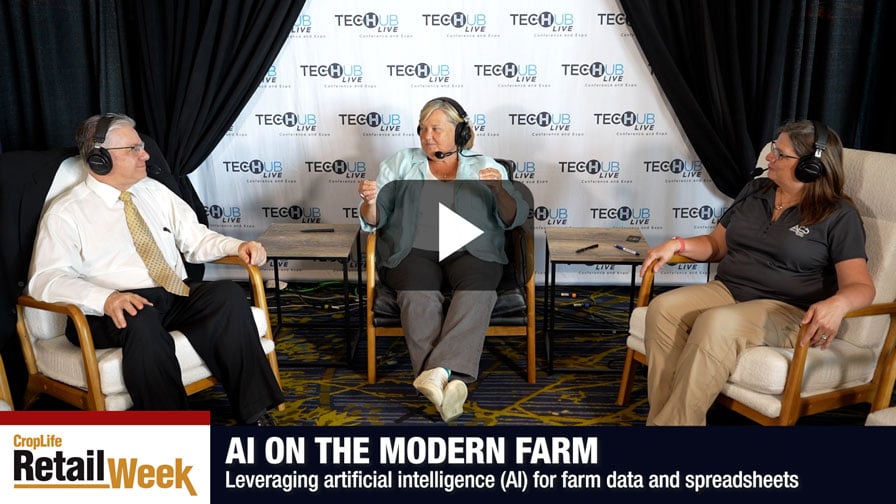
In this special edition of Crop Life Retail Week recorded live at Tech Hub Live 2026 in Des Moines, Iowa, host CropLife Editor Eric Sfiligoj is joined by co-host Amy Asmus, Co-Owner of Asmus Farm Supply and special guest April Hemmes, Owner of Hemmes Farms. Together, they dive deep into the real-world adoption of ag technology—moving from office management to in-field efficiency. From the rapid shift to auto-steer technology to the rise of AI spreadsheets, targeted spraying, and data privacy concerns, Hemmes shares what growers actually need from their ag retailers.
Can’t see the video? To view it, please accept cookies by clicking the icon in the bottom-right corner of the screen, or click here.
♦ Subscribe to CropLife Retail Week’s Youtube Channel
Below is a partial and edited transcript:
Eric Sfiligoj
Welcome to a special edition of CropLife Retail Week. I’m Eric Sfiligoj, editor of CropLife and CropLife Iron, and a member of the CropLife Media Group. I’m here with my co-host, Amy Asmus from Asmus Farm Supply, and our special guest, April Hemmes from Hemmes Farms.
April Hemmes
I go by many different names.
Eric Sfiligoj
Very good. That works.
This is a special edition because we’re recording here at the 2026 Tech Hub Live conference in Des Moines. April, welcome to the program. We’re glad to have you.
We’re here at Tech Hub Live. I’m assuming you’ve had a chance to look around. What has impressed you?
April Hemmes
It’s amazing to me. I was just talking to Megan and Mark Kaiser, the Visionary Farmer Award winners, and Megan said, “I can’t believe all these people are here just for us, for agriculture.”
What surprises me is all the innovation going on and the willingness to share it with others, and how much collaboration is happening. It’s really great.
We were talking at the Women in Tech session yesterday about how agriculture is such a small world. If we all work together, we can all make it a lot better.
Eric Sfiligoj
Very good.
I’ve been doing a lot of stories on technology and ag technology in particular. Our magazine, CropLife, looks at ag retailers, so we have a lot of data on that. To get a better picture of what’s happening on the farm side, I’ve been reading surveys on how growers are utilizing technology.
I’ve been surprised that many surveys indicate growers are primarily adopting new technologies in the office rather than in the field. One survey showed roughly an 85/15 split.
So, a two-part question: Why is that happening, and how do we move the needle to get more technology into the field?
April Hemmes
That’s a great question.
I think a lot of farmers are operating more like businesses than traditional farms. Every decision has a significant impact on our bottom line, so we want to get those numbers right. Subscribing to different services helps us make better decisions and be better on every acre.
When people ask me what technology should do, I tell them to put it on my phone. My phone is with me everywhere. Make it portable.
A school teacher once asked me why farmers needed auto-steer. I said, “Are you kidding?” By not steering the tractor, I can look up markets, watch what’s happening in the world, and do so many other things.
The more portable technology is, the better it is for farmers.
Eric Sfiligoj
That’s interesting. Auto-steer is one of the fastest-adopted technologies I’ve ever seen in agriculture. It seemed like it went from introduction to widespread adoption almost overnight.
April Hemmes
Especially for the older guys.
I had an older employee helping on the farm. I told him the auto-steer was already set up. All he had to do was push a button at the end rows.
He said, “I love driving the tractor.”
The next day he came back and asked, “Can you set that thing up again?” because he realized how nice it was.
Once people get familiar with technology, it’s much easier for them to adopt it.
Eric Sfiligoj
That’s funny. I remember an equipment dealer telling me about a younger grower who called because his auto-steer wasn’t working. The dealer asked, “Why don’t you just drive it manually?” The grower said, “How would I do that?”
April Hemmes
I had a young man working for me, and one day he wasn’t in the field where I expected him to be.
I had loaned my auto-steer receiver and monitor to a neighbor. When I told him that, he said, “Well, I didn’t want people to see how I drove to that field from the road.”
It’s funny how dependent people become on these technologies.
I was talking to someone last night about how the older farmer used to drive the planter because they had all the knowledge. Now, in many cases, that job has shifted to the grandchildren because technology comes naturally to them. They grew up with it.
I didn’t grow up with it, but I’ve had to learn it.
Eric Sfiligoj
The good thing about the older generation is that we can still go back to manual methods. I can still pull out a pen and paper and balance a checkbook.
April Hemmes
I still have my planter markers.
Eric Sfiligoj
Very good.
Thinking about the technologies here at Tech Hub Live, what have you seen that excites you? What could become the next auto-steer in terms of adoption?
April Hemmes
There are so many things.
Anything that brings value to my farm interests me. I won’t just say yield because value goes beyond yield. Sometimes you don’t see a yield increase right away, but there are other benefits.
I’m interested in technologies that are good for the farm and good for the land.
Eric Sfiligoj
Can you name one or two examples?
April Hemmes
You put me on the spot.
One example is the efficiency improvements in spraying technology, like what one of the award winners discussed. I’m out there with a broadcast sprayer, but I have to ask myself: Is the product really hitting the plant? Is it doing what it needs to do? Can I use less?
Technologies that improve efficiency are exciting.
But the biggest thing is affordability. It has to be affordable for farmers.
I’m a relatively small farm, a little under 1,000 acres, so I need technology that I can justify financially. If it’s going to make me better and be worth my while, then I’m interested.
I also like technologies that integrate with other systems and help create more value from the corn and soybeans I produce.
There are a lot of technologies that can bring value back to the farm, even if they aren’t directly involved in production. For example, innovations that create new uses for agricultural products after they’re grown.
Eric Sfiligoj
One of the speakers this morning mentioned having information available through a handheld device. I’ve talked to ag retailers who are starting to use AI applications on their phones to support agronomists working with growers.
What are your thoughts on AI?
April Hemmes
I’ve been asked that a lot.
I always say farming has been using AI for a long time. Even auto-steer is a form of it. Sometimes it thinks it knows where I want to go, and I have to tell it otherwise.
More recently, I’ve used AI to help build spreadsheets and perform administrative tasks for the farm.
But you still have to have human knowledge. You have to ask the right questions. Once AI systems develop a stronger knowledge base and understand what information I need, they’ll be even more useful.
I really look forward to seeing where it goes.
I often think about my grandfather, who started farming with three horses and lived long enough to see auto-steer. Will the next generation be farming from a laptop while everything runs autonomously? I hope not completely.
I get bored in a tractor, which is why I like auto-steer. It lets me do other things.
Anything that makes us more efficient and better on every acre will be adopted if farmers see value in it. It always comes back to value.
Eric Sfiligoj
One note of caution, though.
I’ve started using ChatGPT and similar AI tools to help summarize long research papers and white papers. It can take something that might have taken me a day and a half to read and give me the top takeaways in seconds.
But I’ve been told you have to be careful about what information you share with these platforms because data ownership and privacy can become concerns.
Who owns the data is already a major topic in agriculture. How do you balance the benefits of AI with concerns over sharing information?
April Hemmes
I get asked about data ownership a lot.
It really comes back to generational differences.
Some people think, “This is mine. You can’t have it. I’m not sharing it.”
Then you have younger generations who are comfortable sharing almost everything.
For me, I’ll share my data if I get something valuable in return. Whether that’s money, information, or insights that make me better, there has to be value for me.
I didn’t realize some of those AI platforms made information public, though.
Eric Sfiligoj
It depends on the platform, but it’s definitely something people should be aware of.
Amy Asmus, my co-host, is here representing the ag retailer side of the business. I’ve probably monopolized the conversation.
As technology adoption continues to evolve, what role should ag retailers play in helping growers?
April Hemmes
Were you going to ask me that, or is he just taking over?
Amy Asmus
This is fascinating. The less I have to talk, the better. I’m loving this.
April Hemmes
My message to ag retailers is this: gain knowledge. Go out and learn. Then use that knowledge to filter information for your customers.
My agronomist is like my farming husband. He knows me better than almost anyone. He knows what I value, what I want, and what I will actually use on my farm.
Ag retailers need to do the research because there is so much information for farmers to process. If you can filter that information and identify what is truly valuable to me, that’s incredibly helpful.
You come to a conference like this and realize there are so many products and technologies available. I didn’t know I needed so much stuff.
There are a lot of people working hard on behalf of agriculture.
Amy Asmus
You talked earlier about collaboration.
It’s no longer me versus you versus the neighbor down the road.
One reason I love that farmers were invited to this event is that most of these shows are geared toward ag retailers. I work with growers who do a lot of their own application work.
The question becomes: Are there tools that help us while also helping our growers? We need growers to share data with us so we can make better recommendations and help improve their farm.
This event creates an opportunity for farmers to hear the retailer’s perspective, understand the value retailers provide, and see how technology supports that relationship.
April Hemmes
Whenever I attend conferences and tell people I’m a farmer, they get excited.
One retailer told me yesterday that they rarely get to speak directly to farmers. Usually information moves through a chain: the developer talks to the retailer, and the retailer talks to the farmer.
At the end of the day, farming is about partnerships. I need trusted partners. I can’t know everything.
Amy Asmus
Sometimes people think trade shows are just places where someone is trying to sell them something.
But I think the real value is in the conversations.
With technology, companies often deliver what they think we need. Sometimes that’s not exactly right. We need those conversations where we can say, “You’re close, but it also needs to do this.”
The people using these tools every day need to have input so companies understand what’s actually needed in the field rather than just what they think should be developed.
April Hemmes
Exactly.
I’ve talked with startups before. They’re excited about a new product, and then I tell them, “That won’t work on my farm because of X, Y, and Z.”
Sometimes they simply haven’t considered those realities.
Farmers need to be willing to share information if they want the technology to improve. We want these technologies to succeed because, in the end, they’re supposed to help us.
Eric Sfiligoj
I think that answers it.
All right, that’s about all the time we have today.
April, thank you so much for joining us. Amy, as always, it’s a pleasure. I love seeing everyone in person.
Thank you for joining us for this special edition of CropLife Retail Week from the 2026 Tech Hub Live Conference. We hope you enjoyed the discussion, and we’ll see you again next week.
Thank you.