The Big Crush: Trump, Xi, and Domestic Demand
 September 23, 2026
 When President Donald Trump sits down with China’s President Xi Jinping, soybean farmers in northern Illinois and across the country would like them to talk about soybeans.
“That means working toward a durable trading relationship,” Ohio farmer Scott Metzger, current president of the American Soybean Association (ASA) said in a recent ASA news release. ASA would like Trump to encourage Xi to keep his commitment to buy 25 million metric tons of U.S soybeans annually, 2026 through 2028.
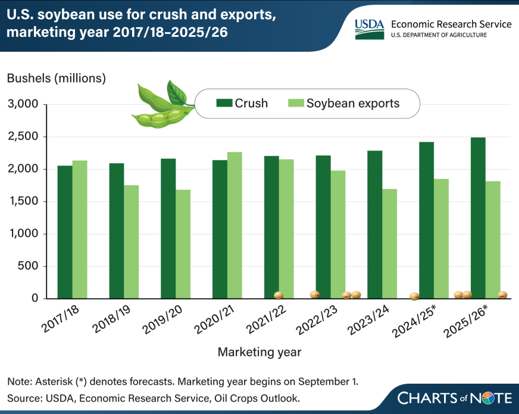
But feeding Chinese hogs and chickens aren’t the only thing bringing out the best from America’s soybean farmers, especially given that’s just a fraction of past U.S. soybean exports to that country. No, what’s causing them to chase more pods and bigger beans is all the new crush plants springing up from Ohio all the way to the Dakotas. Big players are responding to demand for aviation fuel, biofuels and renewable diesel with big infrastructure that will need a constant supply.
The latest crush facility announcement comes from CHS, Inc. — the nation’s largest farmer-owned cooperative — in Evansville, Wisc. The $700-million investment is the first large-scale soybean crush plant in the state with planned capacity to process 80 million bushels of soybeans each year.
“For farmers, this is about more than a new processing plant; it is a new market for their soybeans,” said Devin Mogler, National Oilseed Processors Association president and CEO. “Our industry has expanded at a remarkable pace, and we are on a path toward processing two out of every three rows of soybeans grown in the U.S.”
Domestic crush levels have exceeded the year-ago levels for 17 months in a row, showcasing the continued industry investment and growth. Given this new, more local demand, a crop often denigrated by many as just a rotational crop between seasons of King Corn is now gaining more scrutiny, care and love.
“You can push soybeans throughout the season based off what they’re dealing with,” said Robert Phillips, agronomist with Integrated Seed Solutions of Flanagan, Ill. “You can find ways to get them to set more nodes and add another cluster of pods through foliar feeding and different biostimulants.”
Veteran agronomist Larry Fiene, founder and CEO of Planet Earth Agronomy, an agronomic consulting and product development company based in Mt. Horeb, Wisc., says chasing high yields means planting more beans and that brings the need to manage stress the plants will encounter all season long.
“The main stress that’s created in the soybean field is by the farmer, and it’s by design,” he smiles. “If we wanted stress-free beans, we’d plant 60,000 seeds per acre. But we plant them at 100,000 to 120,000 (seeds per acre) to get the maximum amount of production, so that brings stress from competing with other bean plants in the field. As farmers we’re growing the maximum amount of yield based on the carrying capacity of our soil. We know where we need to be, and we run it right to the edge.”
Fiene has considerable experience evaluating high-yield soybean systems. He’s spent decades evaluating how biologicals, nutrients, and biostimulants can be applied to prepare soybeans to endure hardship to grow taller, branch out more, set more pods, and support bigger beans. He and his team at Planet Earth Agronomy developed and rigorously tested a new formulation, dubbed Big Bean, that combines Boron (2.35%), Nitrogen (2%), Potash (1%), seaweed extract (Ascophyllum nodosum) and other components into one product designed to:
- Enhance soil health, nutrient cycling, and plant vigor through natural biological processes.
- Enhance plant metabolic efficiency, improve stress tolerance, and optimize nutrient uptake without being a fertilizer or pesticide.
- Improve soil structure, nutrient availability, microbial activity, and plant metabolism.
- Boost plant enzyme function, metabolism, and yield expression.
For Mike Robbins, a fifth-generation farmer from just south of Chicago, the benefits have been clear.
“We set a record yield with our soybeans last year with BIG BEAN as a part of that. I’m excited to see what it does this year,” Robbins says. “We saw about a four bushel per acre increase across 2,000 acres over our previous record, which is pretty incredible.”
Robbins says he and his father saw a lot of return on a pretty small investment from a product that was easy to integrate into their system. “We put it in with our post- herbicide pass and we put it in with our fungicide pass. It’s as simple as measuring it and dumping it in the tank.”
Standing in a soybean field in northern Illinois recently, Robert Phillips says he’s been counting pods and enjoying the journey toward higher and higher yields with a domestic market that’s ready to use them.
“Each node on a soybean plant has the potential to put 12 pods on,” he says. “I’ve never seen it personally, yet, but I’m working on it. I’m going to get there. I had nine pods last year, and that’s unheard of. It’s been a lifetime goal to get there, but there’s still a lot of that mountain to climb.”
Subscribe Today For
