The challenge for ag retailers is no longer collecting data. It’s turning field-level information into decisions that improve outcomes for growers and create stronger advisory relationships. As input costs remain high and margins stay under pressure, retailers need tools that help them identify problems sooner, prioritize recommendations, and demonstrate measurable value acre by acre.

For Maia Donahue, vice president of product at Taranis, the real opportunity lies in helping advisors connect field data to business outcomes. “Our goal is to help translate the threats that we are seeing within the field to a prospective impact in terms of real bushels per acre,” she says.
Moving Beyond Scouting Limitations
Field scouting remains one of the most important services retailers provide, but it comes with practical limits. Agronomists often manage dozens of growers and thousands of acres, making it impossible to physically inspect every acre with the same level of detail.
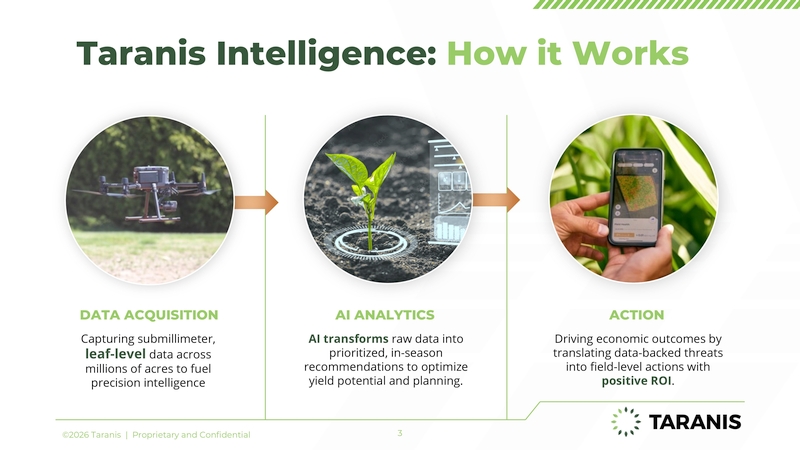
According to Donahue, Taranis addresses that challenge by combining drone imagery, AI-powered analytics, and agronomic expertise to deliver leaf-level insights across entire fields. The system captures submillimeter data throughout the growing season and converts that information into prioritized recommendations designed to support yield and profitability.
“We’re collecting millions of acres of data, and we’re using that to fuel our precision intelligence,” explains Donahue. “At the end of the day, it’s not about the fancy data or the fancy AI. It’s about what actions you can take and how you can use those decisions and recommendations to drive a better outcome for your fields and operation.”
The platform uses drones in a six-flight cadence for corn and soybeans, beginning with stand counts shortly after emergence and continuing through key growth stages to monitor weeds, diseases, insects, nutrient deficiencies, and overall crop health.
“Every drone flight needs to have a resulting action,” notes Pablo Bruzzoni, vice-president of customer experience and agronomy at Taranis. “The idea is to provide the information you need at the right moment to make a decision.”

Turning Data Into Recommendations
Capturing leaf-level imagery across an entire field is only part of the equation. To help advisors quickly interpret that information and turn it into action, Taranis developed Ag Assistant™, an AI-powered tool that combines field observations with weather, soil, planting, application, and operational data. The platform provides agronomic context alongside Taranis imagery, helping retailers prioritize issues, identify likely causes, and make more informed recommendations without spending hours sorting through data.
“Ag Assistant is all about turning that data complexity into clarity,” explains Donahue. “As the agronomist, advisor or grower, you get a clear view of exactly what’s happening within your field and can put those insights into the context of everything else we know about that field.”
Putting Yield Impact Into Context
One of the company’s newest capabilities focuses on translating field observations into economic outcomes. Rather than simply identifying weeds, diseases, or nutrient deficiencies, Taranis estimates the potential yield impact associated with each threat.
The Yield Impact™ tool quantifies how many bushels per acre could be lost if a detected issue goes unmanaged. By combining crop stage, weather conditions, stand establishment, and field observations, the system helps advisors determine whether intervention is warranted.
“Our goal is to help translate the threats that we are seeing within the field to a prospective impact in terms of real bushels per acre,” says Donahue. “We’re quantifying the risk of not taking action so that growers and advisors can make the right decision.”
That capability is especially valuable as retailers work to prioritize fields and recommendations during busy periods.
“Now you can see all your fields at the same time,” emphasizes Bruzzoni. “You can prioritize where to go first because you know which field has the biggest problem and where to take action immediately.”
Delivering Real-World ROI
Donahue shares several examples to illustrate how field-level intelligence can create measurable value.
In one stand-count scenario, severe weather led to significant emergence challenges across a corn field. Taranis imagery identified the most heavily affected areas, including portions far from the road that could easily have been missed during conventional scouting. Using replant zone maps, the grower targeted only 41 acres for replanting rather than replanting the entire field.
The result was an estimated savings of roughly $2,100 to $3,300 in unnecessary seed costs while still protecting yield potential.
Another case involved a rapidly expanding weed infestation that covered nearly the entire field within just 16 days. Species-level identification revealed that the majority of the infestation consisted of aggressive grasses and volunteer corn, requiring a different herbicide strategy than originally planned.
“The species distribution proved this wasn’t a standard weed problem,” says Donahue. “If the grower had followed the original plan, they could have wasted money on the wrong application while allowing the weed pressure to continue impacting yield.”
Instead, the agronomy team recommended a targeted graminicide application. The estimated outcome included more than $5,000 in yield protection, prevention of an ineffective spray application, and a return exceeding 10 times the cost of the service.
Turning One Season Into Next Year’s Plan
While in-season decisions remain important, Taranis is also focused on helping retailers carry insights forward into future seasons. New field-specific season summaries automatically synthesize emergence data, weed pressure, disease observations, insect activity, weather patterns, and management outcomes into a single report.
The reports include two new metrics: Yield Impact Realized, which estimates bushels lost to threats during the season, and Yield Impact Avoided, which estimates bushels preserved through timely management decisions.
“This is what lets an advisor tell a concrete ROI story,” says Donahue. “Here’s what you lost, and here’s what your management decisions saved you.”
The season summaries also generate recommendations for the following year, giving retailers a framework for winter planning discussions and positioning them to recommend products, management changes, or new programs based on documented field performance.
For retailers, that means stronger conversations backed by data instead of assumptions.
“We’re expecting people to grow their acres because they experience the value,” concludes Bruzzoni. “You’re helping growers be more profitable while giving advisors more time to focus on serving their customers.”
As precision agriculture continues to evolve, the opportunity for retailers is becoming clearer. The winners will not be those with the most data. They will be the ones who can translate that data into timely, field-specific recommendations that growers trust, act on, and see reflected in their bottom line.
If you missed the live broadcast of this webinar, “Turning a Season of Crop Intelligence into Action” you can view the archived version online here or visit CropLife.com/webinars and check it out today.