With fertilizer costs remaining a significant input expense, growers cannot afford to assume product is reaching every row. A single blocked fertilizer line can create an unseen problem that affects crop performance all season long. For ag retailers, that makes flow monitoring an important tool for helping customers protect their fertilizer investment and improve application confidence.
The Cost of a Missed Row
One of the biggest challenges with fertilizer application is that problems are often invisible. A fertilizer system may appear to be operating normally while one row receives little or no product.
“With the cost of fertilizer, you really can’t afford to not have every single row putting fertilizer out,” cautions Ethan Bartel from Wilger. “If there’s a blockage, most of the lines are not clear, so you really have no way of knowing until later on when those plants grow and you notice that the fertilizer has not hit that one row.”
By that point, the grower has already invested in seed, fertilizer, fuel and labor. The opportunity to correct the issue may be gone, and the affected row can struggle to keep pace with the rest of the crop.
Flow monitoring helps eliminate that uncertainty by verifying that fertilizer is moving through every row during application rather than relying on visual crop symptoms weeks later.
Simple Monitoring Delivers Valuable Visibility
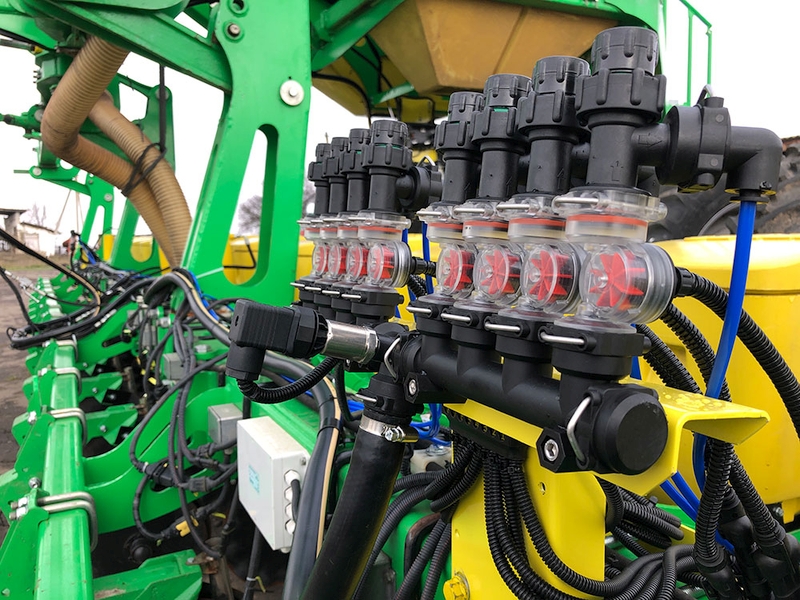
For many growers, visual flow indicators remain an effective first line of defense against application issues.
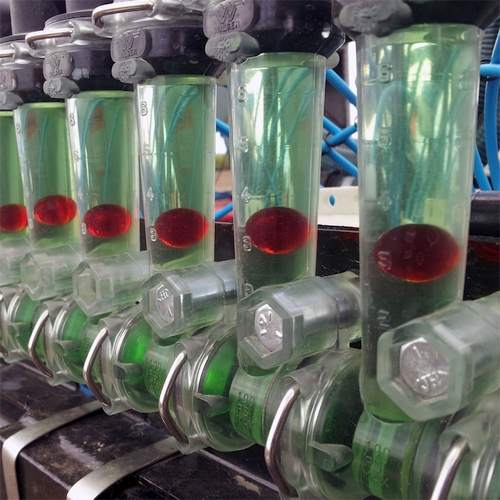
These systems use a floating ball inside each indicator to show whether fertilizer is moving through the line. If a blockage occurs, the ball drops. If a line breaks, the ball rises, providing an immediate visual cue that something is wrong.
“They’re very simple. They’re mechanical. There’s not a lot of things that can go wrong,” explains Bartel. “They’re going to let you know if your line is busted, because your ball will be higher than the others, and if you have a blockage in your line, the ball will be lower than the others.”
For operators running smaller planters, applying clear liquid fertilizers and planting primarily during daylight hours, visual indicators often provide the visibility needed to catch major problems before they impact crop performance.
When Electronic Monitoring Makes Sense
As planter sizes increase and fertilizer programs become more complex, visual monitoring can become more challenging.
It is not always practical for operators running large equipment to continuously turn around and inspect every row. Visibility can also become an issue when using darker products, such as humic acid-based fertilizers or when planting after dark.
To address those situations, growers can use Electronic Flow Monitoring (EFM) systems that provide row-by-row flow information directly in the cab. This provides increased safety as the grower doesn’t have to continuously look back at the visual indicators. Rather, the operators can monitor application performance through a tablet display while continuing to focus on the job at hand.
The technology also provides greater sensitivity to flow changes.
“If someone wants to be a little bit more precise than just, ‘Is it flowing or is it not?’ then the EFM would be for you,” Bartel says. “You’re able to see smaller changes in flow, especially on the tablet, versus just turning around and looking to see if the ball is floating.”
That added precision can help identify developing restrictions before they become complete blockages, minimizing the risk of uneven fertilizer application across the field.
Matching Monitoring to the Operation
The right monitoring approach depends largely on the operation.
According to Bartel, a grower running a 12-row planter with clear fertilizer products during the day may find that traditional visual indicators provide all the information needed. Larger operations often benefit more from electronic monitoring.
“If you’re running a 24-row planter, mostly at night or running dark humic acid, that would be where that electronic flow monitor would justify the cost,” he says.
An added advantage is that many growers can integrate electronic monitoring with existing visual flow indicator systems rather than replacing equipment entirely.
Helping Growers Protect Every Dollar of Fertility Investment
For ag retailers, the value proposition is straightforward. Fertility programs are built around delivering nutrients where and when the crop needs them. If fertilizer never reaches part of the field because of a blocked line, the return on that investment is immediately reduced.
Flow monitoring helps growers confirm that product is reaching every row, every pass. Whether through simple visual indicators or advanced in-cab monitoring, the objective is the same: identify problems before they affect crop performance.