Artificial intelligence has quickly become part of the production agriculture conversation. For ag retailers and agronomists, that reality brings both opportunity and skepticism. Questions about accuracy, data privacy, and the role of human expertise often dominate the discussion.

According to Zach Worden, senior product specialist at TELUS Agriculture & Consumer Goods, retailers should view AI through a practical lens. “AI isn’t coming for your job. But an advisor who learns to use it just might be,” he says. The key distinction is important. AI is not replacing agronomists. It is becoming another tool that helps them work faster, uncover insights from growing volumes of farm data, and spend more time with customers.
Agriculture’s Data Challenge
The agriculture industry is generating more information than ever before. Soil tests, imagery, yield maps, weather data, scouting reports, inventory records, machine telemetry, and product labels all contribute to an expanding pool of information.
According to McKinsey, Stratus Ag Research, agriculture now produces more than one billion gigabytes of data globally annually, yet less than 20 percent of farm data is used for management decisions.
“The problem in agriculture isn’t a lack of information,” explains Worden. “It’s that we have more data than ever, but less time than ever to connect it.”
That challenge creates an opportunity for AI. Rather than generating entirely new information, today’s generative AI tools can help organize, summarize, and connect existing data sources to surface insights faster.
But success starts with the foundation.
“Good data in, good data out,” Worden emphasizes. Retailers still need accurate, connected, current, and properly structured information if they expect AI tools to deliver useful recommendations.
AI’s Evolution in Ag
While AI may feel new, agriculture has been building toward this moment for years.
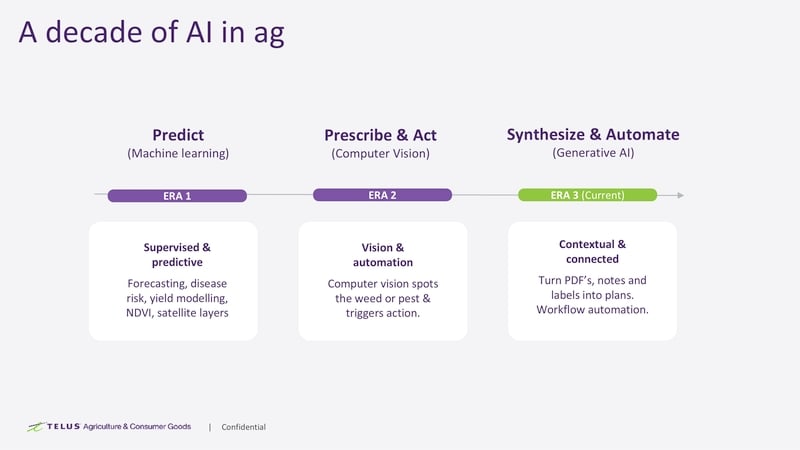
According to Jordan Hazell, product leader at TELUS Agriculture & Consumer Goods, the industry has already moved through distinct phases of AI adoption. Early efforts focused on prediction through machine learning, such as disease forecasting, yield modeling, and weather-based risk assessments. The next wave introduced computer vision technologies capable of identifying weeds or pests and triggering equipment responses in real time.

Today, the agriculture industry is entering what Hazell describes as a contextual and connected era.
“It reads what you already have, like lab PDFs, scout notes, product labels, and turns them into summaries, plans, and insights,” he explains.
Unlike previous technology shifts that required significant new hardware investments, generative AI can build on existing digital infrastructure and datasets. That helps explain why adoption is accelerating. According to McKinsey Global Farmer Insights data, 17 percent of growers are already experimenting with generative AI for agricultural tasks.
Why Human Expertise Still Matters
Despite the excitement surrounding AI, grower trust remains firmly centered on people.
Research shows that only six percent of growers view AI tools as a trusted source for farm decision-making.
For retailers concerned that growers will use AI to bypass agronomic expertise, Hazell sees a familiar parallel.
“When a patient feels sick, what’s the first thing they do? They go check out WebMD,” he says. “But ultimately, does the patient prescribe their own specialized medication? Do they perform their own surgeries?”
The same principle applies in agronomy. Generic AI tools may provide information, but they lack field-specific context. They do not know a grower’s drainage patterns, past management decisions, localized weather events, or operational constraints.
“Growers don’t want AI-only advice,” notes Hazell. “They want AI-informed recommendations validated by someone who knows their soil.”
That role becomes even more important when AI makes mistakes.
Worden offers an example involving satellite imagery that identified a stressed area within a field. An agronomist familiar with the location immediately recognized the cause.
“He said, ‘I know exactly what that is. That’s where the geese land and pick the crop apart,’” recalls Worden.
No dataset contained that detail. No algorithm could infer it. The example highlights a reality that is unlikely to change anytime soon: AI can identify patterns, but local expertise remains essential for interpretation.
The Battle Against Administrative Drag
For many retailers, the most immediate value of AI lies in reducing administrative burdens.
Agronomists and retailers spend an excessive amount of time during a typical workweek on non-advisory tasks such as data entry, documentation, record management, logistics, and information gathering.
“We call it the time leak,” says Worden. “The time isn’t coming out of paperwork for its own sake. It’s coming out of the work growers actually value.”
This is where many AI applications are gaining traction. Advisors can use AI to summarize reports, organize documents, extract information from PDFs, identify trends, prepare meeting briefs, and consolidate records from multiple systems.
“Generative AI helps across a range of tasks,” says Hazell. “At the simple end, there are things that even I use our own company-approved AI system for every day, like summarizing what’s in this file, identifying trends, sentiment, or action items.”
The goal is not full automation. It is creating more time for customer-facing work.
Start Small, Think Practical
For retailers considering their first steps with AI, both Worden and Hazell recommend a measured approach.
“Start now and stay curious,” recommends Hazell. “Test one task, one field, one workflow.”
Rather than chasing flashy applications, advisors should focus on solving specific operational challenges that consume time and attention. Administrative workflows often provide the fastest path to measurable value.
Most importantly, retailers should remember that AI does not replace the trusted relationships that drive decision-making in crop production.
“Growers want AI-informed advice but retailers are the ones who makes it informed,” concludes Hazell. “AI brings speed and scale, but the advisor’s context and institutional knowledge is what ultimately creates a recommendation.”
As AI becomes more common throughout agriculture, the most successful retailers will not be those who adopt technology for its own sake. They will be the advisors who combine digital tools with local expertise, turning data into clear recommendations that growers trust.
Learn more at TELUS Agronomy.
If you missed the live broadcast of this webinar, “AI isn’t Coming for Your Job. But an AI-Enabled Advisor Might Be.” you can view the archived version online here or visit CropLife.com/webinars and check it out today.