
Despite a difficult environment for growers in 2026, the value of the U.S. seed market is expected to rise by 2.5% over the previous year. This growth is being driven by increased seed pricing. It is also aided by a greater overall planted area of key crops.
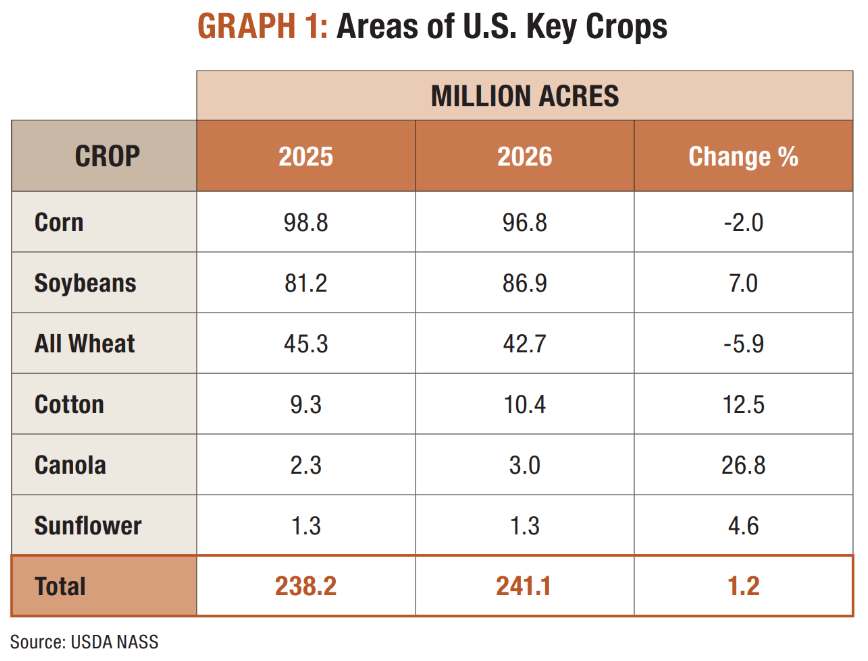
The USDA’s September National Agricultural Statistics Service (NASS) Production report estimates that the 2026 U.S. soybean area has risen by 7% to 86.9 million acres. Not only has the U.S. returned to its alternating yearly pattern of corn vs. soybean areas, but soybeans were also forecast to provide greater grower financial returns, or at least less negative. As a result of a larger soybean area, corn is expected to have declined by 2%. The 2026 U.S. cotton area is expected to have risen by 12.5%, while the wheat area fell by 5.9%.
The two most valuable seed markets in the U.S. are corn and soybean, worth a combined $16.9 billion at the farmgate level in 2026, a rise of 4% over the previous year. The combined sales of corn and soybean typically represent around 85% of the U.S. seed market.
Historically, the drivers of the U.S. corn and soybean seed markets were a combination of new technology, specifically biotech traits, and the beneficial impact of rising commodity crop prices. However, in recent years, newly introduced technology has provided small incremental gains in pricing, resulting in the U.S. corn and soybean seed markets being greatly impacted by the prevailing commodity crop price.
Historically, biotech trait introductions were significant in their value impact as they transferred grower expenditure to control specific crop pests away from conventional crop protection products to within the seed.
Newly introduced technology such as the use of RNAi (ribonucleic acid interference) in the control of corn rootworm, are typically secondary and tertiary technologies that aim to increase the number of genetic modes of action of control or are additive to technologies that are losing efficacy.
Dealing with Negative Returns
In 2026, U.S. growers were faced with a negative financial return situation for both corn and soybean production, where expenditure was above the gross value of production (the value of the harvested grains/oilseeds). In this situation, to alleviate financial pressure, growers may reduce spending on inputs, as has been seen in the conventional chemical crop protection sector, or increase the gross value of production by raising yield/production.
In 2026, both approaches appear to have been taken by U.S. growers, spending less on crop protection and more on seed to increase production. Unfortunately, below optimal weather has resulted in the national average yield of both corn and soybean production declining in 2026, with corn falling 7.58 bushels per acre to 166.54 bushels per acre and soybean declining 0.15 bushels per acre to 52.79 bushels per acre.
The value evolution of the seed market is closely related to the performance of the companies operating in the sector.
The summed North American sales of the four largest global seed companies in the first half of the 2026 calendar year were positive in comparison with the first half of 2025, led by greater revenues of both soybean and corn seed. Bayer and Corteva are the industry’s largest seed companies with revenues greatly exceeding their peers. In the U.S., their combined activities account for 60% to 70% of the corn and soybean markets.
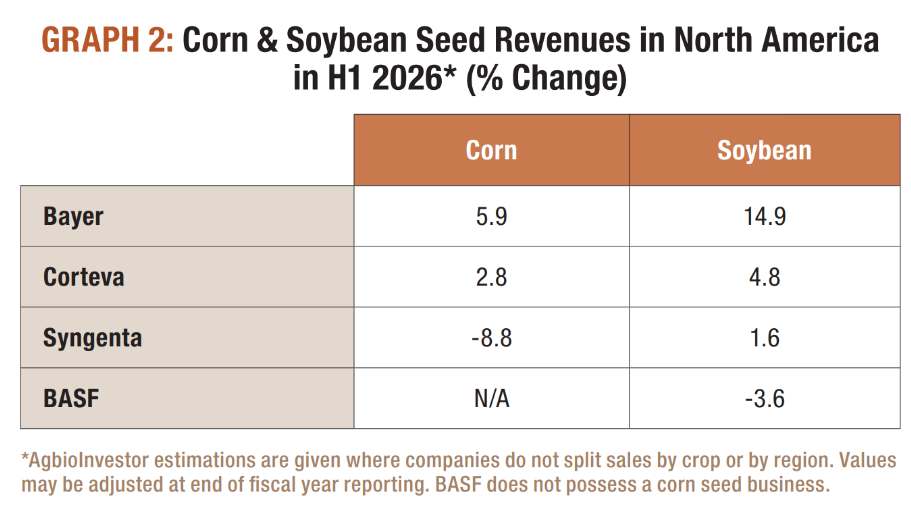
The corn and soybean revenues of both companies are estimated to have increased in 2026, with soybean sales aided by a larger U.S. planted area, and corn by higher seed prices. Bayer’s soybean seed sales are anticipated to exceed average market growth due to the return of the dicamba herbicide label and greater sales of Xtend/Xtend Flex seed products, which are tolerant to dicamba.
The Outlook for 2027
Looking into 2027, AgbioInvestor expects the U.S. to swing back into a corn year where the planted area increases at the expense of a smaller soybean area. The U.S. cotton area is likely to decline in 2027, based on the recent trend of oscillating planted area, while it is likely that the country’s wheat area increases based on rising demand and favorable trading price.
Based on area alone, the transition of planted area from soybean to corn innately increases the value of the U.S. seed market, as expenditure on corn seed is almost twice as much as soybean on a per area basis. Seed prices are likely to continue to rise as commodity prices are currently expected to further increase in 2027.
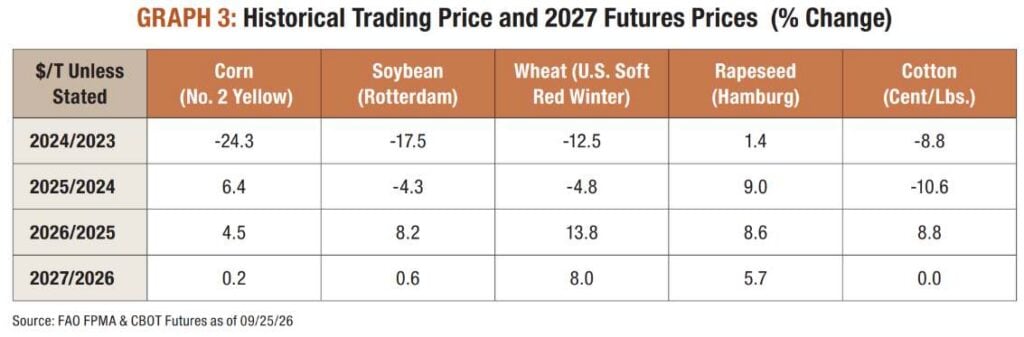
With greater areas of high-value crops and seed prices for next year looking favorable, there is the potential for another year of growth for the U.S. seed market in 2027.