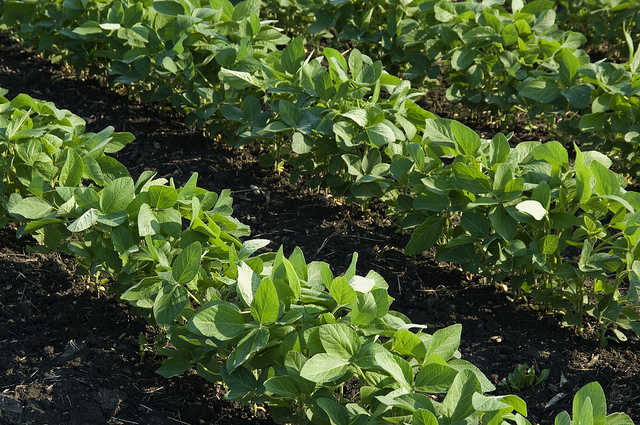
What do you need to change to raise 125 bushel soybeans?
“The definition of insanity is doing what has always been done, and expecting different results,” said Travis Burnett, Field Agronomist for Becks. “The purpose of the high yield plots is to get outside our comfort zone and try different things, then work backwards with the results to see what can practically be applied to our traditional research.”
Becks has been conducting high yield corn and soybean plots for several years, using the latest seed technology combined with overhead irrigation, subsurface drainage and subsurface drip irrigation, writes CCA Dusty Sonnenberg at Ohio’s Country Journal.
“Our challenge from Sonny Beck is to hit 125 bushels per acre,” Burnett said. “In 2020 we hit 117.”
One area which the team is trying new things to reach the goal is in how nitrogen (N) and sulfur (S) are managed in the crop.
“A soybean plant uses 4 to 5 units of nitrogen per bushel of beans produced,” Burnett said. “That means a 60-bushel per acre soybean crop uses between 240 and 300 units of N per acre. Our research has indicated that the N fixed in the soil by the nodules can be sufficient for up to 90 bushels per acre.”
When supplementing N in a soybean crop, application timing is critical.
“If N is applied too early, it can make the beans lazy and not produce the nodules sufficiently to fix the necessary N,” Burnett said. “The majority of N uptake by the soybean occurs from R2-R4. This happens to be the same time the N fixation in the soil is decreasing. In our high yield plot we are trying to fertigate 140 units of N from R4-R5.”
Read more at Ohio’s Country Journal.