
Looking at 2007, it’s fair to say that the ag retail marketplace is about to enter some uncharted waters. As corn acreage grows, custom applicators could be hard-pressed to keep up with increased work requests.
Regardless of how the year plays out, however, one thing is certain — retailers will rely on their equipment to keep pace. This isn’t surprising, says Dave Lovell, product manager/application group for AGCO Corp., Duluth, GA, given the role application equipment has in the ag retail community.
“Essentially, these units serve as mobile offices for custom application operators,” says Lovell. “Over the years, they’ve come to expect that the manufacturers will do all they can to make their equipment easier and more efficient to run.”
In recent years, this desire for efficiency of operation has led to larger spray rigs, sporting 120-foot booms and 1,000-gallon holding tanks. According to Jim Collins, vice president of GVM West, Bellevue, OH, “big rigs” are expected to remain popular with custom applicators in 2007, but some operators are looking for versatility.
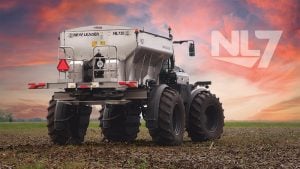
“Since there’s a lot of down time with traditional units, you are starting to find more customers looking for equipment that can play many parts, such as combination units that switch between sprayers and spreaders,” says Collins. “In a lot of cases, you have companies trading in two or three of their older, single application units for a single multi-purpose one.”
Increasing In-Cab Options
Within the cab itself, custom applicators in 2007 should expect to see more high-tech options available. Ken Lehmann, marketing manager for Case IH Application Equipment, Racine, WI, says today’s hottest item in is automatic boom section control.
“By minimizing skips in the field, it provides economic return by reducing weed pressure of the crop in the skipped areas as well as the expense of additional application trips,” says Lehmann. In the future, he adds, automatic boom section controls that work with “just several” nozzles or even on a nozzle by nozzle basis could appear.
Lehmann predicts the time will come when the units in the field will actively “talk” with their home bases. “Managers will be able to remotely ‘call up’ a machine for downloading the application data, find out the current location of the equipment for logistical purposes, and other system status readings on the unit,” he says. “The ‘call ups’ also will allow for remotely updating software and diagnosing and troubleshooting suspected problems.”