
As soybean fields move through reproductive growth stages, growers may notice SDS-like symptoms, but another disease with strikingly similar symptoms is becoming increasingly important in the Midwest: red crown rot.
Proper diagnosis is critical because management strategies and future field decisions may differ depending on whether sudden death syndrome, red crown rot or both are present.
Red crown rot infections in Louisiana and Mississippi have documented yield losses of 25% to 30%. It usually only affects patches in the field, but severely infected fields can be significantly impacted. Late-planted and double crop soybeans are especially susceptible to severe infections due to warmer soil temperatures during early growth development.
Although symptoms are often first noticed after the R3 growth stage, red crown rot infects roots during early vegetative stages. The fungal disease causes root and stem rot before producing a toxin that may trigger the foliar symptoms growers commonly observe.
Red crown rot shares a similar infection process and foliar symptoms with sudden death syndrome. Both diseases cause root discoloration, interveinal chlorosis and premature plant decline.
“We have seen some fields that had both SDS and red crown rot,” said Carl Bradley, University of Kentucky professor and Extension specialist, during a Forward-Thinking Farming webinar. “It’s important when you’re trying to figure out what’s out there that you look at a number of plants because there might be a number of diseases out there, so just because you see SDS in one little area, that may not be what’s affecting the entire field.”
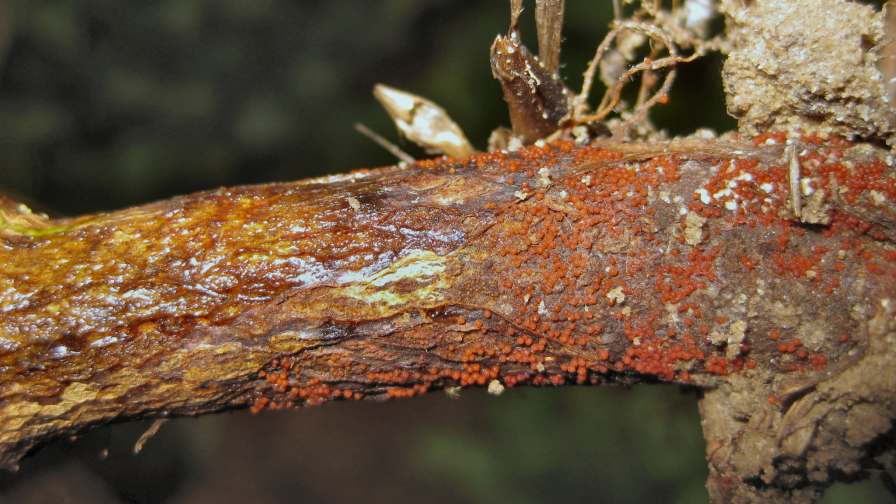
The key distinguishing characteristic of red crown rot is the presence of perithecia on the crown and roots just below the soil line, which look like tiny red balls and will give the crown a reddish color. Sudden death syndrome may have a blue discoloration on the outer surface of the taproots and a milky gray-brown discoloration of the outer cortex while the inner core remains white, which may extend several nodes into the stem.
Management options for red crown rot and sudden death syndrome are limited and no rescue treatments are available to mitigate plant damage and yield impact once infection has been detected. Neither red crown rot nor sudden death syndrome can be eradicated after they are introduced, so accurate identification helps growers make management decisions that may reduce disease impact in future seasons.
Growers can reduce both red crown rot and sudden death syndrome symptoms with practices, such as:
- Choosing tolerant varieties
- Applying fungicide seed treatment
- Rotating non-host crops
- Reducing stress and compaction
- Improving field drainage
- Managing root-feeding insects and nematodes
- Adjusting planting date
There is currently limited information about varietal tolerance for red crown rot. While most soybean varieties have a tolerance rating for sudden death syndrome, Pioneer® brand Z-Series soybean varieties are noted for their strong defensive traits and improved SDS resistance.
Some management practices reduce both diseases, but planting date recommendations differ. Research shows that early planting can limit red crown rot, while sudden death syndrome is reduced with later planting.
Because red crown rot and sudden death syndrome can produce nearly identical foliar symptoms, examining roots and crowns remains the most reliable way to distinguish between the diseases and inform future management decisions.