
Precision agriculture continues to evolve beyond individual machines, with connected equipment, artificial intelligence (AI), and data-driven decision-making reshaping how growers manage their operations. As OEMs expand their digital capabilities, the focus is increasingly shifting toward creating open ecosystems that connect equipment, agronomic insights, and dealer services to improve productivity and simplify farm management. Helping lead that effort at AGCO is Jena Holtberg-Benge, who was appointed Senior Vice President and Chief Digital & Information Officer earlier this year after previously leading the company’s Aftersales Parts business and helping drive digital and AI-enabled initiatives supporting dealers and farmers.
CropLife recently spoke with Holtberg-Benge about AGCO’s vision for connected equipment, the challenges surrounding interoperability and data governance, where AI is already delivering measurable value, and why the ability to transform farm data into actionable insights, not simply hardware or software alone—will define the next generation of precision agriculture.
CropLife: How is AGCO approaching the integration of digital tools, machine systems, and data platforms to create a more connected equipment ecosystem for growers and dealers?
Jena Holtberg-Benge: Our goal is to make connected farming simpler and more useful for growers and dealers. We are building an open, connected ecosystem that links machines, farm operations, agronomic insights and dealer services. Through our partnership with Trimble and our digital platform investments, we can support mixed fleets across multiple brands, reflecting the diverse equipment many farming operations use today.

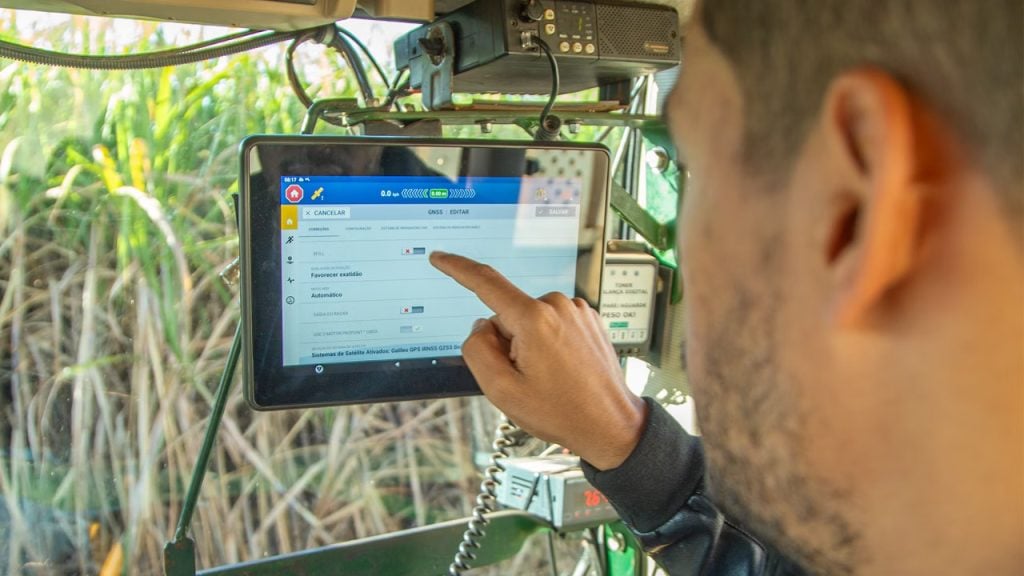
Our platform brings together machine connectivity, telemetry, farm operations management, agronomic task execution and data-driven decision support into a single environment. That allows growers to manage existing equipment in one place, regardless of brand. Connectivity also gives dealers access to machine diagnostics and operational insights that can improve uptime and simplify service interactions. Ultimately, the goal is to move beyond machine connectivity and use data to support better agronomic decisions.
CL: What are the most significant technical or structural challenges today in scaling precision agriculture—particularly around interoperability, connectivity and data flow across platforms?
JHB: One of the biggest challenges is making technology work across the mixed fleets and varied systems growers already use. Equipment, software environments, cloud architectures and data standards differ across the industry, so the goal has to be an open, neutral platform that connects those pieces in a practical way.
ISOBUS has helped improve implement interoperability, but it does not solve the broader challenge of connecting data, workflows and platforms. Today, cloud-to-cloud integrations are the most effective way to link multiple ecosystems. Longer term, the industry needs more open, interoperable data architectures that can support real-time insights, AI and automation.
The objective is not simply to collect data, but to make it more useful by supporting better operational and agronomic decisions. That includes capabilities such as predictive maintenance, application optimization, field-level recommendations and autonomous workflow execution.
CL: Where are you seeing the strongest real-world applications of AI within OEM systems today, and where is the industry still in early or experimental stages?
JHB: Today, the strongest real-world applications of AI within OEM systems are in areas with abundant structured data, repeatable processes and clear operational outcomes. Demand planning, supply chain optimization, procurement and customer support have already demonstrated meaningful value. AI is improving forecast accuracy, helping identify demand shifts earlier, optimizing inventory levels, automating supplier interactions and enabling faster decision-making across complex operations.
In manufacturing, AI is increasingly being used for quality management, predictive maintenance, computer vision inspection and production scheduling. While many of today’s AI deployments occur within manufacturing and enterprise operations, those efficiencies ultimately improve how equipment, software and services reach growers.
Another area gaining traction is the use of AI assistants embedded within ERP, planning and procurement systems. Rather than replacing planners, buyers or operations teams, these tools augment human decision-making by analyzing large volumes of data, identifying exceptions, recommending actions and helping employees navigate increasingly complex processes.
Within agriculture, some of the most promising applications sit at the intersection of connected equipment, precision agriculture and AI. We’re beginning to see AI combine machine telemetry, agronomic data, weather information and operational data to provide more predictive recommendations for growers. While many of these capabilities are already delivering value today, the industry is still exploring connected ecosystems where enterprise systems, digital platforms and field equipment work together to optimize decisions across equipment management, field operations and agronomic planning.
CL: As equipment becomes increasingly connected, how is AGCO evolving machine design to function as part of a broader data and analytics ecosystem rather than a standalone tool?
JHB: Connectivity is already part of the foundation of how we design and validate machines. New machine platforms are increasingly designed to capture machine and agronomic information so we can better understand performance under real-world conditions.
That information also helps growers compare multiple layers of field and machine data, supporting decisions around crop rotation, nutrient management, seed selection and weed control. From a design standpoint, we’re taking a systems approach—using agronomic and machine data not only to improve equipment performance but also to better support on-farm decision-making.
CL: How is AGCO addressing data governance and security as machines, platforms and third-party systems become more tightly integrated?
JHB: At AGCO, we view security and data governance as foundational to connected agriculture. As machines, platforms and partners become more integrated, trust matters just as much as functionality.
That means governance and security need to be designed into the ecosystem from the start, with clear policies, standards, access controls, monitoring and risk assessment throughout the data lifecycle. It also means clearly defining ownership and accountability as data moves between machines, cloud platforms, dealers, growers and technology partners.
We also place significant emphasis on third-party risk because security extends beyond any one organization. As AI and advanced analytics continue to scale, we’re strengthening governance around data usage, model security and responsible AI adoption. Effective data governance is essential for enabling broader connectivity while maintaining security, privacy and reliability.
CL: From an OEM perspective, what will be the key differentiator over the next three to five years—hardware innovation, software ecosystems or the ability to operationalize agronomic data at scale?
JHB: Hardware and software will both continue to matter, but the real differentiator will be the ability to turn farm and machine data into practical decisions and measurable outcomes.
Today’s machines, sensors and digital platforms generate more information than any individual can reasonably manage. The value comes from closing the loop—moving from sensing to interpretation to recommendations and, where appropriate, action in the field.
Success will depend on connecting mixed fleets, translating machine and agronomic data into actionable insights and delivering those insights through the digital tools and service networks growers already rely on. Growers and ag retailers don’t need more dashboards—they need technology that helps prioritize actions, improve machine performance, reduce downtime and support better agronomic and business decisions.