
Micronutrients rarely dominate fertility plans, yet they often determine how far a crop can go. Across today’s production systems, retailers are seeing the same pattern: strong macronutrient programs paired with inconsistent performance that is harder to explain. The issue increasingly traces back to micronutrient availability.
“Most fertility programs heavily emphasize nitrogen, phosphorus, and potassium, often overlooking micronutrients until deficiency symptoms become visible,” says Kuide Qin, chief science officer at Verdesian Life Sciences. “Modern high-yield production systems continue to increase nutrient demand while depleting soil reserves and reducing overall nutrient availability.”
Intensive management, environmental stress, and shifts in soil chemistry are widening micronutrient gaps even in well-managed fields, leaving retailers to manage variability that standard programs do not fully address, and growers seeing uneven growth or yield potential that falls short of expectations.
The Limiting Factor in Plain Sight
Qin points to a familiar principle to explain why micronutrients matter so much. “Growth and yield are determined not by total resources, but by the single, scarcest limiting factor,” he says, referencing Liebig’s barrel. “Inconsistent micronutrient availability acts as the short stave. It constrains key physiological processes, leading to reduced nutrient use efficiency and ultimately, yield loss.”
Even small gaps can disrupt enzyme function, photosynthesis, and reproductive development, and the timing of deficiency often compounds the impact. If availability drops during early vegetative growth or grain fill, the crop has limited ability to recover. The result is not just lower yield, but uneven crop performance that complicates management decisions across the season.
Where Traditional Delivery Falls Short
Retailers know micronutrients are important, but delivering them effectively remains a challenge. Traditional approaches tend to focus on correcting visible deficiencies rather than preventing them.
“The main issue with traditional micronutrient delivery systems is variability,” Qin says. “Poor soil availability, low mobility, timing mismatches, and environmental factors all contribute to inconsistent plant uptake and an inability to meet crop demand throughout the season.”
In practice, that variability shows up as multiple applications, reactive management, and uncertain returns. Nutrients may be present in the soil, but not in a form or location the plant can access when it needs them. For retailers, this translates to more complexity in program design and less predictability in results.

A Shift Toward Consistent Availability
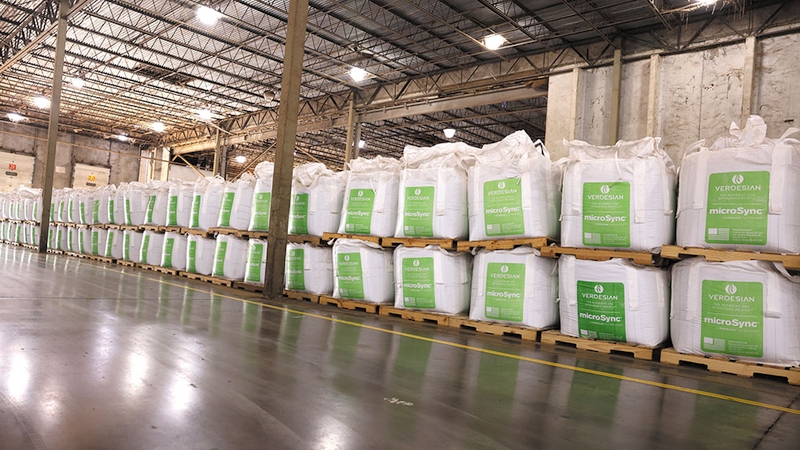
Newer delivery systems, on the other hand, are built around a different objective: consistent availability in the root zone over time. Jake Socherman, general manager of micronutrients at Verdesian Life Sciences, says that is where technologies like MicroSync® are focused.
“MicroSync and other advanced micronutrient delivery technologies are designed to solve the availability problem at the root zone,” notes Socherman.
He points to Verdesian’s Nutripaction® manufacturing process, which creates uniform granules by combining sulfates and sucrates into a single fertilizer particle. Unlike traditional blends where nutrients can separate or be distributed unevenly, Nutripaction helps ensure micronutrients are delivered consistently across the field and positioned where roots can access them. The result is more predictable nutrient availability throughout the growing season and improved opportunities for plant uptake.
“Uniform, plant-available granules release micronutrients gradually and predictably,” Socherman explains. “That leads to more consistent availability throughout the season, better root interception, and improved uptake efficiency.”
The system also incorporates X-Chain® Resin Technology to regulate release based on plant demand while reducing nutrient tie-up. The combined effect is a steadier nutrient supply that supports early vigor and sustained growth without repeated applications.
“MicroSync keeps micronutrients where they matter, in the root zone and available when the plant needs them,” he adds.
Why It Matters for Retailers
For ag retailers, the shift toward controlled, consistent delivery aligns with broader changes in crop production. Larger operations, tighter labor availability, and pressure to maximize return on every input all demand simpler, more reliable systems.
Technologies that stabilize micronutrient availability can reduce the need for in-season corrections and improve the efficiency of existing fertility investments. They also help standardize performance across variable soils and conditions, which is often where retailers see the greatest challenge.
Built for the Next Phase of Crop Nutrition
Socherman frames these advancements within a longer arc of U.S. agriculture. “American agriculture has always been built on innovation,” he says. “Developing micronutrient delivery technologies like MicroSync and proprietary manufacturing processes like Nutripaction here at home reinforces that legacy while strengthening domestic supply chains.”
Looking ahead, he sees micronutrient delivery as a core piece of more precise, efficient systems. “The next era of agriculture will be defined by precision, efficiency, and sustainability,” Socherman predicts. “These technologies help growers improve nutrient efficiency, increase ROI, reduce nutrient loss, and support higher yields without increasing environmental impact.”
For retailers, that translates into programs that are easier to implement and more consistent in outcome. Micronutrients move from an afterthought to a designed component of the fertility strategy. The benefit is not just filling a gap, but removing a constraint that often goes unseen until it limits performance.
As production systems continue to push yield potential, the smallest elements in the program carry more weight. Delivering them correctly is becoming a central part of staying competitive, acre by acre.

MicroSync®, Nutripaction®, and X-Chain® are registered trademarks of Verdesian Life Sciences.