Nutrien’s Allan Potash Mine: Digging Deep for Productivity, Safety
 March 3, 2026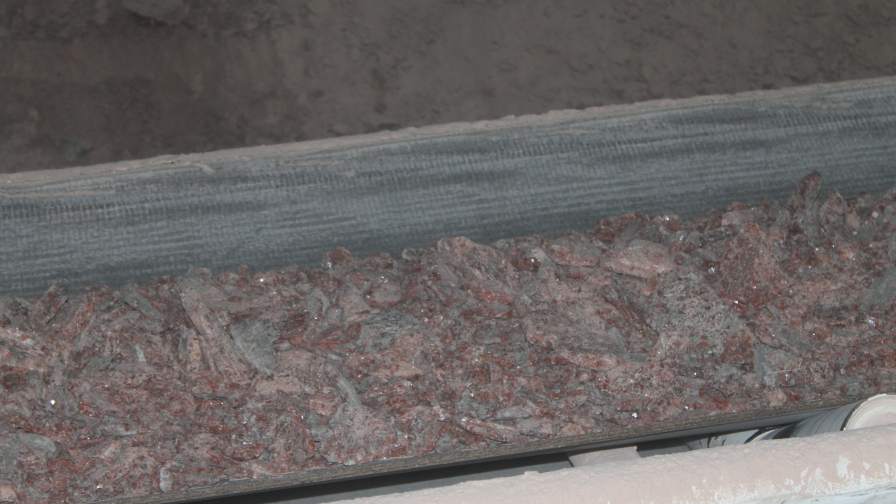
Once potash is cut from the mine walls at Nutrien’s Allan mine, it is moved via conveyor to the surface for processing.
More than 70 million tons of potash are produced worldwide every year. Canada is the world’s largest producer and exporter of the potassium-rich minerals — primarily potassium chloride — that is critical to plant and animal life.
Globally, Nutrien is the largest potash producer. In Saskatchewan, the company operates six mines, including the Allan mine, a conventional underground mining operation with continuous mining machines that excavate potash ore by the stress-relief mining method.
During a recent visit to the Allan mine, Nutrien employees discussed how advancements in safety, resource conservation, technology, and tele-remote mining are improving protection for workers and operational productivity.
Technology Boosts Safety, Productivity
Tele-remote mining and automation have been significant impacts, acknowledges Zoe Belanger, Mine Operations General Foreman at the Allan mine.
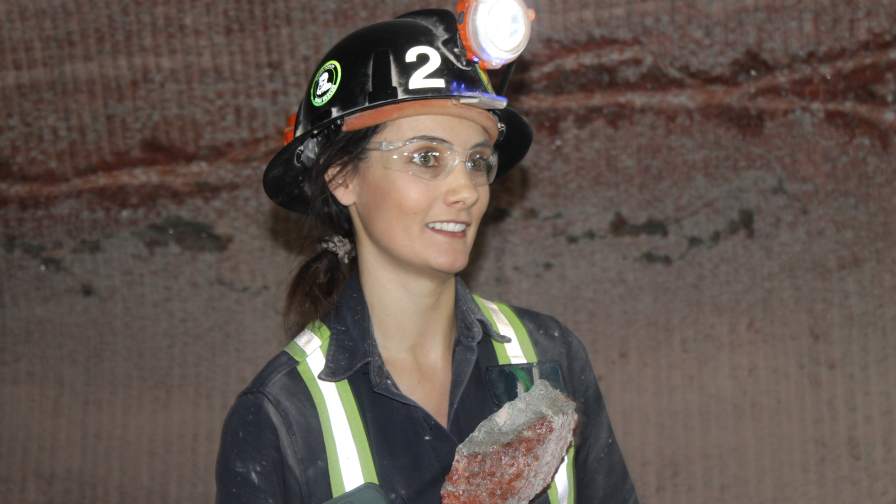
Zoe Belanger, Operations General Foreman at Nutrien’s Allan potash mine, discusses how tele-remote mining and automation dramatically boosts worker safety.
“Ten years ago, people didn’t really think that we’d be able to mine remotely, and now we’re doing it,” says Belanger.
Most importantly, it dramatically boosts worker safety. “It removes them from the active face where there is the highest potential for ground-related issues, such as the stability of those walls, which can be harmful for the operators,” she says.
With tele-remote mining, the operator can be located a few chevrons away (roughly 150 to 300 feet) at a skid structure or stationed up on the surface. About half of the equipment fleet at the Allan is operated remotely, although the goal is to reach 100%, says Belanger. There is also a learning curve associated with tele-remote operations.
“Like any technology, you have people who are early adopters and then some that shy away from it, but you’d be surprised, some of our more senior bore operators have become the best [at adopting new technology],” she says.
In addition to safety, there are impressive productivity gains with tele-remote mining and automation, says Les Frehlich, General Manager at Allan mine, which impacts multiple areas.
For example, maintaining a competitive edge in the market comes down to increasing your volume, Frehlich explains, “and automation is a big piece of that.”
In a typical day, a worker starts with a 1-kilometer descent to the underground mine followed by a “toolbox” meeting to discuss any hazards identified from the previous shift and then travels out to the line where preoperational checks are conducted before the actual cutting begins.
Worker breaks and routine “sound and scale” checks to assure the integrity of the active face are also part of the tasks performed during a typical 12-hour shift.
All told: “We probably only get two to three hours of cutting in a 12-hour shift, but with automation, we can get up to eight hours of cutting in a 12-hour shift, so it’s a gamechanger from a safety and productivity standpoint,” says Frehlich.
Automation and tele-remote mining don’t necessarily mean workers will lose their jobs, however.
“Our plan is not to reduce [Nutrien] labor,” says Frehlich, but it may help the company reduce its reliance on contractors.
As the footprint of the mine grows, there is an increasing number of permanent travelways that need to be maintained, “and we’re utilizing contractors to supplement that requirement. Our goal is to displace contractors as we get more efficient with our own people and maintain a bigger mine.”
Frehlich adds: “That’s what we’re fighting — mine sprawl. We’re trying to keep our costs down as the mine grows. There is more to maintain, more belt lines and so on.”
Sustainability = Good Business
Sustainability is another attribute of the Allan mine that receives a lot of attention. Nutrien’s Curtis Ferguson, Environmental Engineer, says minimizing and conserving natural gas consumption, electricity, water, and other inputs contributes to reduced greenhouse gas emissions and improved productivity.
“We want to make sure that we’re optimizing our usage and not overusing these resources,” says Ferguson.
Ferguson also mentions “all of the ore that’s coming off the belt,” which at 30,000 tons a day or so, means that “there is approximately one-third that ends up being product while the remaining two-thirds has to be safely contained and stored.”
The containment is closely monitored to prevent leaching onto neighboring land and farms. This “nonproduct” is basically sodium chloride and a little bit of clay and therefore not toxic, yet it would adversely affect crops growing in nearby fields.
Ferguson doesn’t see a contradiction in pursuing sustainable operations and running a business.
“You would think there might be, but actually it’s the opposite,” he says. “A lot of our water-use savings comes from limiting the misuse of water in the processing (of potash). Any misuse of water could end up dissolving the product (because it’s basically salt).”
Subscribe Today For
